High Velocity Lube Test

Home Forums NOE Forums NOE Archive Historical Archive Using NOE Moulds At the Range High Velocity Lube Test

  • This topic is empty.
  • Creator
    Topic
  • #487790
    Larry Gibson
      Up
      0
      Down
      ::

      HV Lube Test (14 lubes) Results

      First I want to thank all who donated lubes, GCs, reloading equipment and some money to assist in the completion of this test.  Without your help and assistance the test would not have been as extensive nor as easy to complete.  Thank you all.

      I managed to get to the range early the day before Christmas to conduct this lube test.  It was supposed to be a bright sunny day with 0 – 4 mph winds reaching the high 50’s.  However a cold front came through early so it was a colder 44 – 48 degree day that became overcast just before noon.  Fortunately the wind remained calm most of the day but did pick up to about 3 mph late in the tests.  The wind was out of 5 – 6 o’clock so it did not measureably effect the results. 

      The 14 lubes tested were (in order of test);

      Javelina
      White Label 2500+
      2700+
      Tac 1
      Bullshop LOTAK
      Felix FWFL (original batch)
      Tac X
      LBT Blue
      Voodoo Red
      White Label Carnauba Red
      Lyman’s Orange Magic
      Gear’s SL-68
      Gear’s SL-68.1
      Lyman’s Super Moly

      NOE 30 XCB bullets cast of #2 alloy and WQ’s with a BHN of 22 – 23 were visually sorted (twice) for defects and weight sorted with the selected bullets at 158.7 +/- .1 gr. The selected 30 XCBs , after 30+ days of aging, had Hornady GCs seated in a Lyman 450 Lubrasizer with a .311 H&I die installed. The Lyman GC seating tool for the 450 was used so only the GC was initially seated and partially crimped.  The NOE nose punch that comes with the NOE mould for the specific bullet was used.  Once the GCs were seated they were lightly sprayed with a lanolin/alcohol lube and were pushed through a .311 Lee sizer.  Since the bullets were .3105 as cast the Lee sizer only finished crimping the Hornady GCs on the base of the bullets.  The bullets were sorted in lots of 15 each for each one of the lubes.  That was 210 30 XCB Bullets for this test.

      The Lyman 450 Lubrasizer already had 2500+ lube in it so the 15 bullets for 2500+ lube were lubed in it.  The .311 H&I die only lubed the .3105 bullets.  The other lots (13) of 15 bullets each were hand lubed.  I made sure all the lube grooves were full and left an excess of lube on the bullets.  The excess was cleaned off with another pass through the Lee .311 sizer.  Each bullet was once again inspected to make sure the lube filled each groove completely.  The weight for the fully dressed bullets varied slightly (+/- .2 gr) based on the lube.  I used the weight of 164.7 gr for the data input as that was for 2500+ lube which seemed to be close to “average”.

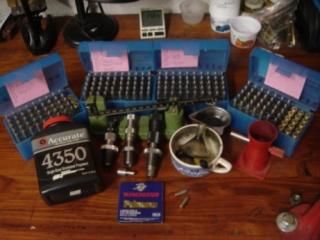
      The cases used were Winchester Palma .308W cases that were match prepped and well fire formed in the test rifle. They were neck sized in a Redding Bushing die with a .335 bushing.  The NOE M die case mouth expander for the Lee Case Expander die was used.  The NOE expander slightly sized the inside of the case necks at .309 and flared the case mouths at .311.  The cases were primed with Wincher large rifle (WLR) primers using a RCBS bench mounted priming tool. 

      The powder for this test was AA4350 at 47 gr.  That has proven to be a consistently accurate load over the last few months with the NOE 30 XCB Bullet in the test rifle.  Accuracy has consistently run from just under moa to 1.6 moa over many 10 shot groups.  That load has been producing 2600 fps +/- with 2500+ lube in the 85 – 110 degree temperatures.  The velocity during this test (2578 fps with 2500+ lube) dropped a bit due to the colder temperature of 44 – 48 degrees.  That was expected.  The 47 gr load is right at 100% load density in the Winchester fire formed cases with the seated NOE 30 XCB bullet. 

      The powder charges (47 gr each) were individually weighed to .05 gr +/- on a Redding balance beam scale.  All of the AA4350 used was from the same canister.  The 30 XCB NOE bullets were seated to the specified OAL (bullet ogive against the leade) with a Bonanza Forster Benchrest Seater.  The 15 rounds for each lube were sequentially placed in MTM Cartridge boxes.  Once loaded the ammunition was maintained in an upright position until each round was removed from the cartridge box.
      DSC02221.jpg

    Viewing 15 replies - 16 through 30 (of 34 total)
    • Author
      Replies
    • #495069
      bjornborud
      Participant
        Up
        0
        Down
        ::

        I sent the 2700+ to Larry. In turn I was given the lube by Goodsteel. It came in a baggie with the 2700+ label, and was dark blue in color. When I asked Tim about the color (subsequent 2700+ lube was dark red), I was told that the blue lube was part of a custom lot to a customer who specified blue color. I have now used both lubes, shot both at 3K+, and I cannot see any difference in the performance.

        #495070
        swheeler
          Up
          0
          Down
          ::

          Dang CBlue :o!

          #495071
          swheeler
            Up
            0
            Down
            ::

            I hope Glenn sees this and can comment on it. Scot

            #495072
            daveridenour
            Participant
              Up
              0
              Down
              ::

              Larry,

              Another outstanding report! Thank You for posting!

              This deserves being a Sticky, not just for it’s content, but also for showing how to do a technical/scientific report.

              Dave

              #495073
              ianharris
                Up
                0
                Down
                ::

                Larry, my sincere thanks to you for doing these tests.  A note on the SL lubes, you did me a great service by testing both though I only intended for you to spend your energy/resources on one.  By testing both, though, we can see what “too much” oil does to a lube.  The 68.1 is only soap, microwax, heavy mineral oil (GL-1, SAE 140 Weight), and a touch of castor oil, while the 68 only has enough heavy oil to temper the wax and the overall lube viscosity is adjusted with Vaseline and white mineral oil, as well as the same amount of castor as 68.1.  My experience showed the 68.1 to be very “flyer sensitive”, just as you have, and comparing it directly to the 68 version tells us that “too oily” definitely has a detrimental effect on the all-important “Consistency Of Residuals Encountered” factor as can be positively seen in your detailed pressure vs. velocity vs. POI documentation. 

                Your work showing the internal ballistics/POI in a very clear manner is simply invaluable to those of us chasing and attempting to eliminate the lube variables in our home-brew mixtures.  Those looking for a commercial solution for HV cast shooting can certainly look to the top lubes from your test to eliminate what has been a huge unknown to most in the past.  While alloy choices, lube groove design, and a host of other things can affect the way a particular lube “groups” in a particular rifle/load combination, the first-shot-POI distance from main group that a given lube produces is usually very consistent regardless of group performance or rifle/load, and is thus a fairly reliable indicator of what extra testing or bore prep one needs to do for a hunting-type scenario when choosing a particular lube formula.

                Again, THANK YOU.

                Gear

                #495074
                sgt.mike
                  Up
                  0
                  Down
                  ::

                  Larry, my sincere thanks to you for doing these tests.  A note on the SL lubes, you did me a great service by testing both though I only intended for you to spend your energy/resources on one.  By testing both, though, we can see what “too much” oil does to a lube.  The 68.1 is only soap, microwax, heavy mineral oil (GL-1, SAE 140 Weight), and a touch of castor oil, while the 68 only has enough heavy oil to temper the wax and the overall lube viscosity is adjusted with Vaseline and white mineral oil, as well as the same amount of castor as 68.1.  My experience showed the 68.1 to be very “flyer sensitive”, just as you have, and comparing it directly to the 68 version tells us that “too oily” definitely has a detrimental effect on the all-important “Consistency Of Residuals Encountered” factor as can be positively seen in your detailed pressure vs. velocity vs. POI documentation. 

                  Your work showing the internal ballistics/POI in a very clear manner is simply invaluable to those of us chasing and attempting to eliminate the lube variables in our home-brew mixtures.  Those looking for a commercial solution for HV cast shooting can certainly look to the top lubes from your test to eliminate what has been a huge unknown to most in the past.  While alloy choices, lube groove design, and a host of other things can affect the way a particular lube “groups” in a particular rifle/load combination, the first-shot-POI distance from main group that a given lube produces is usually very consistent regardless of group performance or rifle/load, and is thus a fairly reliable indicator of what extra testing or bore prep one needs to do for a hunting-type scenario when choosing a particular lube formula.

                  Again, THANK YOU.

                  Gear

                  Gear,
                  Curiosity is begging the question in your lube of the SL68 series which component of the lube are you looking at modifying.
                  Thank You
                  Mike

                  #495075
                  lar45
                    Up
                    0
                    Down
                    ::

                    Hello, sorry life’s been busy and I just saw this last night and read it this morning.
                    Outstanding test Larry!
                    The Blue 2700+ should have been the same except for the coloring.
                    All of the ingredients are weighed out on a digital scale.
                    I use a liquid dye vs a pigment, but in a 35# batch there is only 6 teaspoons of dye.  It does take a little more of the blue to get the color right.  I do keep notes and a check list on every batch so it can be repeated.  I don’t make anything from memory.
                    The additional blue dye must have made it softer.
                    BjornB the 2700 that you’ve been testing, is it the blue or red?

                    #495076
                    bjornborud
                    Participant
                      Up
                      0
                      Down
                      ::

                      Glenn,
                      since Tim assured me that they were both the same I’ve been using them interchangeably. I haven’t noticed a lick of difference. I have both the blue and the red, and consistency seems to be identical also.

                      #495077
                      ianharris
                        Up
                        0
                        Down
                        ::

                        Gear,
                        Curiosity is begging the question in your lube of the SL68 series which component of the lube are you looking at modifying.
                        Thank You
                        Mike

                        The wax and the mineral oil.  Hoping for a definitive analysis of the famous “Navy Beeswax” which seems to work so well, then duplicate and use that instead of the BW-431.  With that accomplished, there won’t be a need for the mineral oil ingredient to temper the hard microwax, and an ‘industrial’, low-refined petrolatum will be sufficient for final softening without adding too much “slick”.

                        The basic formula of the SL-68 series does what it was designed to do, so I don’t plan to change the basic formula very much.  The 68 is very consistent in extreme heat and cold, doesn’t tend to throw the first shot out of the group regardless of bore condition (hot, cold, fouled, clean, rough/pitted, polished, stainless steel, carbon steel, CM steel, etc), and is soft enough to not need heat to flow through a sizer. The soft part also makes it very suitable for low-velocity and works well with a variety of lube groove designs and configurations without being sensitive to how many or how few grooves are filled.  The high melt point (200F or higher, with a drop point over 400) makes the lube suitable for extremely hot storage conditions without danger of powder contamination…a feature that solves what is somewhat of a “catch 22” with lubes soft enough to be suited for the deep grooves of some revolver bullet designs that are notorious for having jettison issues with hard, high-pressure lubes.  The fact that the SL-68 lube performs almost as well as LBT in Larry’s test at several hundred fps higher than my intended uses is icing on the cake.  I’ll continue to chase improvements provided they don’t compromise any of the other already proven features of the lube.

                        Gear

                        #495078
                        sgt.mike
                          Up
                          0
                          Down
                          ::

                          Gear,
                          Curiosity is begging the question in your lube of the SL68 series which component of the lube are you looking at modifying.
                          Thank You
                          Mike

                          The wax and the mineral oil.  Hoping for a definitive analysis of the famous “Navy Beeswax” which seems to work so well, then duplicate and use that instead of the BW-431.  With that accomplished, there won’t be a need for the mineral oil ingredient to temper the hard microwax, and an ‘industrial’, low-refined petrolatum will be sufficient for final softening without adding too much “slick”

                          ………………The fact that the SL-68 lube performs almost as well as LBT in Larry’s test at several hundred fps higher than my intended uses is icing on the cake.  I’ll continue to chase improvements provided they don’t compromise any of the other already proven features of the lube.

                          Gear

                          Gear
                          glad to hear your chasing that down and getting refinements accomplished with the formula. Maybe you will find some of that technical beewax that some speak of.

                          http://waxesoilsandfats.tpub.com/00-253-1173.htm
                          http://waxesoilsandfats.tpub.com/00-253-1171.htm

                          #495079
                          tommeboy
                          Participant
                            Up
                            0
                            Down
                            ::

                            Gear, I have not followed the lube thread over there very well. How hard and $$$ is it to make? After seeing two of the main lubes that I use fail pretty bad, I am in search of something different. I think for now the Tac lubes are going to be made into a pistol only lube.

                            #495080
                            lyndalchowning
                            Participant
                              Up
                              0
                              Down
                              ::

                              Wow Larry, another great article from you.  It’s very informative and I can only imagine how time consuming it was for you to test all of them.  Many thanks from all of us.
                                :) :) :)

                              #495081
                              darrinwright
                                Up
                                0
                                Down
                                ::

                                I have nothing further to add, but I wish to thank Larry for conducting this excellent test and Al for making it a ‘sticky’ .
                                Marvelous.

                                #495082
                                mikehupp
                                Participant
                                  Up
                                  0
                                  Down
                                  ::

                                  Well done, Larry. I wish you had tested BAC but I suspect it wouldn’t have been suitable for the velocities tested so it wouldn’t have helped me much anyway. The fouling shot observations were very interesting. As soon as the 50/50 runs out I’ll be using Lars’ BAC and will use your excellent test format (except for the PBL, of course) for more conventional velocities.

                                  Do you think a higher ambient temp of say 75-80 degrees would change things much?

                                  #495083
                                  358 Win
                                    Up
                                    0
                                    Down
                                    ::

                                    Larry, great report as always.  I’ve settled on Javelina Alox Lube as my lube for rifle and handgun shooting.
                                    I still have 9 sticks of it for my Lyman 450.  I’ve posted pictures of groups fired from my Marlin 336SC in .32 Win Special @ 2300 fps using LVR powder of which you commented.  Of course 2300 fps is nowhere near the speeds you were shooting with your .308 Win, but it bolstered my confidence in the use of Javelina none the less.

                                    358 Win

                                  Viewing 15 replies - 16 through 30 (of 34 total)
                                  • You must be logged in to reply to this topic.