NOE 310-165-FN 30 XCB in 10" and 12" twist barrels

Home Forums NOE Forums NOE Archive Historical Archive Using NOE Moulds At the Range NOE 310-165-FN 30 XCB in 10" and 12" twist barrels

  • This topic is empty.
  • Creator
    Topic
  • #487769
    Larry Gibson
      Up
      0
      Down
      ::

      I’ve just completed a test of the NOE 30 XCB bullet in 10” and 12” rifles.  Was it a complete test? No.  Did I seek the best accuracy? No.  What I did was push the XCB to high velocity while maintaining acceptable accuracy where most all other cast bullets lose accuracy.  Before we get into the test results let me explain the test parameters.

      The rifles: the 10” twist rifle is a M1909 Argentine made M98 action with a 24” Adams & Bennet barrel having a 10” twist and chambered in .308W.  The barreled action is bedded in a wood sporter stock (Churchill Arms, England).  The action has not been trued.  The chamber was finish reamed to minimum headspace with a Clymer M118 Match reamer.  The rifle shoots right around 1 moa (10 shot groups) with selected match loads using 168 or 175 Sierra MKs. The rifle has an old original Weaver K-10 scope on it.

      The 12” twist rifle is a M70 Heavy Varmint rifle with a 26” factory barrel on it.  It has been pillar bedded and a rail put in the fore end for a hand stop.  It is a very accurate rifle and shoots ½ moa with 175 MKs.  I’ve “cleaned the 600 yard line several times with it and the 1000 yard line a couple.  For testing it has a Redfield Ultimate 4×12 scope on it. 

      The 30 XCBs were cast of Lyman #2 alloy and WQ’d out of the 4 cavity aluminum NOE mould.  The BHN runs 22 – 24.  They drop at .3105.  The bullets were visually inspected and any visible defect rejected the bullet.  The visually passed bullets were then weight sorted to +/- .1 gr.  Hornady GCs were crimped on using a .311 H&I die in a Lyman 450 with the GC seater used.  They were then light lubed with a spray lanolin lube and pushed through a Lee .311 sizer to fully crimp the GC on.  The GC’d bullets were then lubed in the .311 H&I in the 450 lubrasizer and lubed with 2500+ lube.  Fully dressed the bullets weighed 164.7 gr.

      Cases were match prepped LC Match. Primers were WLRs.  Cases were fire formed and neck sized with a Redding Bushing die to give just a slip fit over the NOE M die expander (a very neat tool BTW) for Lee case mouth expander die. 

      Already knowing which powders gave the best high velocity accuracy with the Lyman 311466 and the LBT 30-160-SP bullets in both rifles I chose to use the same powders under the NOE 30 XCB bullet.  That would give a good comparison.  Thinking the NOE 30 XCB should withstand a bit higher acceleration each powder was loaded over the point where the Lyman and LBTs went over the RPM Threshold and lost accuracy. 

      That brings up “accuracy”.  The objective of this test and the other XCB tests was to push to the highest velocity possible while maintaining 2 moa or less accuracy with linear expansion at 200 and 300 yards or further for 10 shot groups. Why 2 moa?  Because that is the useable accuracy criteria those of us running these tests chose. The 2 moa criteria has been the high power standard for many years.  You can kill deer, coyotes and such all day long with a 2 moa rifle.  Some have a hard time with “useable” and seem to grasp “reasonable” as a good measure.  The two mean the same.  That criteria was chosen because the primary objective is high velocity with accuracy.  Once we find out the upper end of velocity with one set of components that maintain 2 moa or less then we can tweak the load and components for best accuracy, if we want to. 

      All velocities (muzzle) were measured with the Oehler M43 PBL.  For each shot the screened velocity was recorded along with a “proof”, a pressure trace was recorded and the peak pressure and associated Area and Rise of the pressure were recorded.  The averages of velocity and the pressures along with their SD & ES were computed.  The screened velocity was converted to muzzle velocity. On the data sheet for each test string I traced the bullet holes, measured group size (ctc) for record and computed the RPM. Most of the test strings are of 10 shots but 3 have 9 shots (out of 20 test strings).  I also tracked each shots location on the target and numbered each bullet hole on the data sheet accordingly.  This gives a very clear understanding of what is happening during the internal ballistic phase.  This test produced 20 data sheets (both rifles) so I will not post them all.  I will post the pertinent ones that show the top end capabilities of the NOE 30 XCB as tested in each rifle.

      For those enamored with 5 shot groups it is interesting to note that in tracking the shots on target in 7 of the 20 test groups the first 5 shots went into less than 1 moa (1 in the 10” twist and 6 in the 12” twist).  Thus, based on 5 shot groups, we could claim that 35% of our groups were “sub moa” and thus our loads were.  However in doing that we would only be fooling ourselves.

      I have often stated the RPM Threshold (120,000 – 140,000 RPM) is not a “limit” but could be pushed up.  I have said two of the prerogatives for doing so is to use a slower burning powder to slow the acceleration rate and to use a properly designed cast bullet of appropriate alloy to with stand that acceleration rate.  The NOE 30 XCB bullet was design expressly for high velocity.  It is succeeding exceedingly well at 2600 – 2800+ fps in 14” twist barrels.  Let us see how well it does at higher velocity and RPM in the 10 and 12” twist rifles.

      The 10” twist rifle (24” barrel) results;

      I chose two powders to test under the NOE 30 XCB bullet in the .308W rifle with 10” twist; RL19 and RL22.  Both of those powders gave the best accuracy out of this rifle with the Lyman 311466 and LBT 30-160-SP cast bullets.  Both of those bullets began going over the RPM Threshold at about 2300 fps/165,000 RPM with RL19 and about 2350 fps/169,000 RPM with RL22.  Note how both of those bullets and powders have pushed up the RPM Threshold over the incorrectly assumed “limit” of 140,000 RPM.  Both of those bullets held under 2 moa accuracy with linear expansion at 200 yards.  Thus with that baseline to measure against I loaded test strings of 38, 40, 42, 44 and 46 gr of each powder to test the NOE 30 XCB bullet.

      The 38 gr load of RL19 gave 1938 fps, 139,536 RPM at 28,100 psi(M43).  The group size for 9 rounds was 1.2” (I excluded the 1st shot out of the cold clean barrel which always drops low out of the group).  Shots 2 through 6 went into .85”.  The ES was 146 indicating that RL19 does not ignite and burn efficiently at this pressure.  A dacron filler probably would have helped that but no filler was used.

      The 40 gr load of RL19 gave 2075 fps, 149,400 RPM at 31,100 psi(M43).  The group size was 1.5”.  The ES immediately tightened up to where it should be.  In fact this test strings ES or 37 fps and SD of 11 fps were excellent.

      The 42 gr load of RL19 gave 2194 fps, 157,968 RPM at 35,000 psi(M43).  The group size was 1.65”

      The 44 gr load of RL19 gave 2313 fps, 166,536 RPM at 38,900 psi(M43).  The group size was 1.55”.  Again an excellent ES of 30 fps with the SD at 9 FPS.  The Pressure ES was 1,200 psi with an SD of  400 psi which is excellent and demonstrating excellent ignition and uniform burn. 

      The 46 gr load of RL19 gave 2434 fps, 175,248 RPM at 43,700 psi(M43).  As with the much slower 14” twist rifle I am finding the psi of 41,000+ to be very hard on cast bullets of this alloy.  We see while the group size is 1.9” there are 2 and probably 3 flyers telling us that this load is exceeding the RPM Threshold or, at least those 3 shots were.  Dropping the load to 45 gr would probably give close to 2400 fps at 41,000 or less psi and still give us the 1.5 +/- accuracy level we’ve achieved with the other loads.  That is a 100 fps +/- increase over the Lyman 311466 and the LBT 30-160-FN bullets in this rifle with RL19.  That is indicating the NOE 30 XCB bullet is indeed holding up better under the high rate of acceleration and RPM generated in this 10” twist rifle.

    Viewing 15 replies - 16 through 30 (of 39 total)
    • Author
      Replies
    • #494915
      Larry Gibson
        Up
        0
        Down
        ::

        Larry, very impressive. You leave nothing to the imagination.
        Thank you for contributing so strongly to the project!!!
        I notice that you were actually well within your parameters of 2MOA. Do you plan to push further just to see where you break 2MOA, or is this test complete?
        Again, simply fantastic posts. Your results speak for themselves.

        Yes, with the M70 12″ twist I plan on testing the AA4350, RL22 and LvR powders further as mentioned in the post.  I also want to test RL19 and LvR powders in the M1909 10″ twist with the XCB bullet.  Additionally I’m going to test the 40 gr LvR load in my 12″ twist M1A.  However, I have 210 rounds about ready to do the lube test in the Palma Rifle.  And when I get the 16″ twist it will probably move to the front of the line……guess I better go cast a whole bunch more XCBs…….

        Larry Gibson

        #494916
        Larry Gibson
          Up
          0
          Down
          ::

          Thanks Larry. I can not get IMR or H 4350 to shoot at all. Have you done any testing yet? Or plan to with these? I have never tried the AA4350. Maybe I should if it ever shows up here.

          Tomme

          I’ve not used H4350 for several years since I conducted the 6.5 Swede test (posted on the CBF).  It became unavailable in the great Obama buying panic and I’ve not seen any available here for a couple years until recently.  Probably will get some to test in the 30×60 one of these days. Some of the slower burning powders just don’t work in the lower pressure ranges with cast bullets.  Consistent ignition and burning are the main problems.  H4350 might just be one of them.  Hopefully powder availability is getting better(?).

          Larry Gibson

          #494917
          daveridenour
          Participant
            Up
            0
            Down
            ::

            Larry,

            Excellent report again, as usual! I still haven’t been able to replenish my stock of powder either, and I’m running low on a lot of my old favorites. Information like this is most helpful. Thanks.

            Dave

            #494918
            sgt.mike
              Up
              0
              Down
              ::

              :)
              Looking to accomplish along the same line Larry.
              will be picking up some RL-17, borrowing a bit of Lever from Goodsteel and slipping into the superformance just to see what the results will be.
              Before doing so however I will have to re-read your post LoL

              #494919
              ianharris
                Up
                0
                Down
                ::

                Now THIS is what so many folks were anticipating…..and as a bonus your test series can actually be used as a rather straightforward, demonstrated procedure for good accuracy at elevated velocity in standard-twist rifles, simply work up to the loads that shot best and follow the basic directions and comments given about how to load them properly.  Lots of 12-twist factory rifles out there too, so there should be a good following.  The M1A ought to really like that bullet as well.  This should help a lot of people easily get more than is normally expected from cast bullet loads.

                Larry, is there any chance you could post a photograph of chamber casts of both of the rifles used in this test alongside a “dummy” cartridge loaded as-shot with the NOE XCB bullet?  I’m interested in how the nose design plays with the throats of your rifles, might be a very good piece of information for anyone wanting to duplicate these performance levels.

                Gear

                #494920
                Larry Gibson
                  Up
                  0
                  Down
                  ::

                  I can do a chamber cast easy enough.  The 10 & 12″ chambers have different seating OALs so I’ll put a correct OAL loaded cartridge next to each.

                  Larry Gibson

                  #494921
                  ianharris
                    Up
                    0
                    Down
                    ::

                    I can do a chamber cast easy enough.  The 10 & 12″ chambers have different seating OALs so I’ll put a correct OAL loaded cartridge next to each.

                    Larry Gibson

                    That would be great, anything that would give an idea of the throat angles.  I’m finding out that a bullet with a similar nose angle (AM 31-190X) to the bullet you used in your tests here is shooting better in throats that have some freebore and more abrupt ball seat angles than it does in the throat I designed it to match exactly (XCB or SAAMI .30-’06 throat).  This goes against the idea that matching the angles exactly is best, now we’ve both experienced that same thing assuming your .308’s don’t have throats exactly fitting the NOE “XCB” bullet.  Interesting what we discover the more we do this HV thing.

                    I may try to gather up some things to duplicate that last load with Lever powder, I’d like to see just where that would have gone with another grain or two and a little less neck clearance.  If I find anything I’ll be sure and post it up.

                    Gear

                    #494922
                    sgt.mike
                      Up
                      0
                      Down
                      ::

                      :-X  not to mention the military throat LMAO  SAAMI is not even a consideration or a factor

                      You seem to call the 30 Gov’t 1 degree 30 which is true to SAAMI Not Government Specs though see below
                      LC%20Chamber%20Test%200.png

                      #494923
                      Larry Gibson
                        Up
                        0
                        Down
                        ::

                        Here’s the M1909 10″ twist and the M70 12″ twist chamber cast and dummy cartridges.

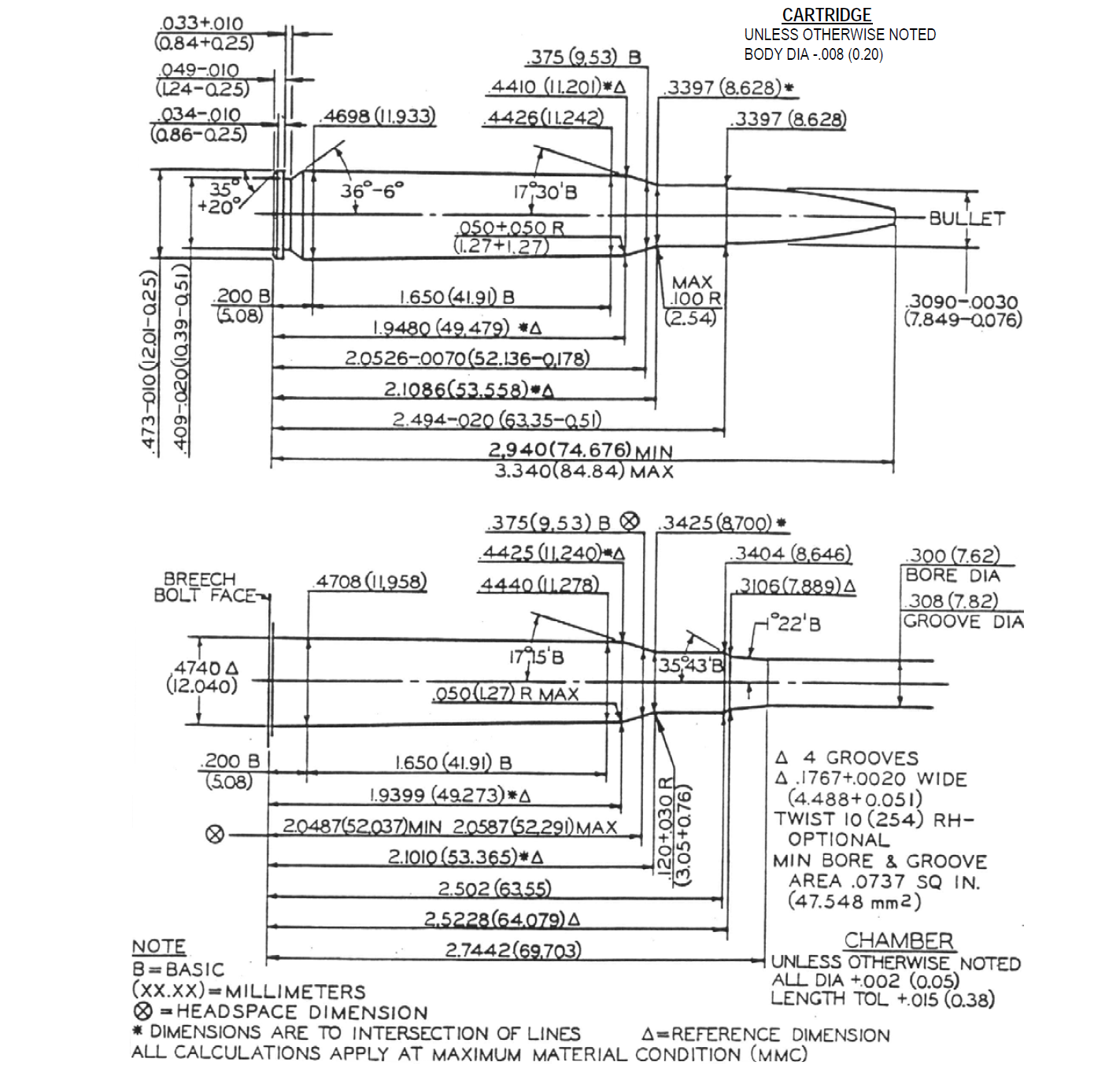
                        The Chamber cast measurements  M1909;
                        Neck at shoulder; .346
                        Neck at chamber mouth; .345
                        Throat at chamber mouth; .312
                        Throat at beginning of leade; .3109
                        Groove diameter 1″ from case mouth .3085
                        Cartridge oal; 2.635

                        Chamber cast measurements  M70;
                        Neck at shoulder; .3475
                        Neck at chamber mouth; .3461
                        Throat at chamber mouth; .310
                        Throat at beginning of leade; .3091
                        Groove diameter 1″ from case mouth .3082
                        Cartridge oal; 2.666

                        The dummy cartridge for each has a 30 XCB seated out and then the cartridge is chambered in the rifle.  The bullet is seated to the listed OAL by the fit of the bullet ogive against the leade.

                        It appears the leade angle is much steeper on the M1909 chamber than the M70’s leade angle.  That may account for the slightly longer OAL of the M70.  It should be noted the M70 has 3000+ full powered jacketed match loads through it where as the m1909s barrel has less than 1000 jacketed loads through it.

                        Larry Gibson


                        #494924
                        Larry Gibson
                          Up
                          0
                          Down
                          ::

                          M70 chamber cast;

                          #494925
                          keithsharp
                          Participant
                            Up
                            0
                            Down
                            ::

                            Larry, Thanks for the test results. I believe most of us can improve grouping with better shooting skills and a more powerful target scope. I recently learned that by loading my bipod (forward pressure) I can hold cross hairs dead steady. A light crisp trigger is a must (practice firing using snap caps). I just purchased a new WEAVER 36 fixed power target scope mounted on Burris Signature rings with offset plastic inserts, Leupold quick detach slotted bases. I believe I can get better grouping now.

                            Here is pound cast of my 1995 vintage Remington 308 Varmint Synthetic rifle (1-12″ twist). This is a NATO chamber with long .150 free bore. Throat slightly worn from shooting jacketed (500 rounds?). Rifle is very accurate regardless of sloppy loose chamber dimensions. One gunsmith once told me that the most important part of the barrel including chamber, is the last 6″ internal dimensions of barrel.

                            I jam the bullet into rifling when chambered. Bullets sized nose first thru my RCBS sizer using .311 die. I hand dip bullets in thinned Alox, but still searching for a better liquid lube for hand dipping.

                            #494926
                            Larry Gibson
                              Up
                              0
                              Down
                              ::

                              Detox

                              Seems I constantly relearn that shooting position and grip are essential to consistent groups.  In the recent test the two rifles had completely different fore ends.  The M1909 had a rounded sporter forend and the M70 had a “beaver tail” target forend.  The M70 was heavier also.  The difference was in the way they recoiled on the bags.  The M1909, as the velocity increased recoiled more (naturally) and also began torqueing if I did not tighten up the hold.  If I did not hold the rifle solidly it would get away from me and vertical stringing of 2″+ could easily result.  The M70 recoiled more as the velocity increased but the nature and fit of the beavertail forend to the front bag prevented torqueing. 

                              Standard “benchrest” shooting techniques of a very light hold and grip many times do not work with some rifles, especially as the recoil increases.  When we get loads down to around 2 moa or less or have vertical or horizontal stringing or unaccounted for flyers want to focus on the usual “suspects” such as lubes, sizing, alloys, powders etc. or that something is wrong with the rifles bedding, crown or scope to get the groups as small as they read about.  They forget, or even just ignore, that perhaps it is they who just can’t shoot any better than that which accounts for some of the inaccuracy.  Shooting, whether benchrest or some other position, requires a constant reinforcement of marksmanship fundamentals regardless of how good we think we are.

                              That is a good choice of scopes for testing.

                              Larry Gibson

                              #494927
                              keithsharp
                              Participant
                                Up
                                0
                                Down
                                ::

                                Detox

                                That is a good choice of scopes for testing.

                                Larry Gibson

                                I was surprised to see how clear the target is using this scope. Mine has the 1/8 target dot, but I wish I got the fine cross hair version. The fine cross hair lets you concentrate more on the tiny Orange dot on official cast bullet targets. Some say the mirage can be bad in the summer time when barrel heats up using a 36 power scope…I may need a mirage shield on top of barrel. Scope is mounted high.

                                #494928
                                Larry Gibson
                                  Up
                                  0
                                  Down
                                  ::

                                  No doubt the mirage shield will be needed.  Even with 10X the mirage coming off the barrel in the summer can cause considerable POA error.  I use one most often when the ambient temp is above 70 degrees.  Scope height for known distance shooting is not relevant as long as the rifle is kept level and a consistent cheek weld is used.  Helps a little with mirage off the barrel though, especially if there is a decent crosswind.  But then you must contend with the crosswind.  I most often just use a rolled piece of target paper around and taped to the objective bell of the scope.  The new Weavers are good scopes and see a lot of use in benchrest competition. 

                                  Larry Gibson

                                  #494929
                                  keithsharp
                                  Participant
                                    Up
                                    0
                                    Down
                                    ::

                                    Some use a small electric fan to blow across barrel to prevent mirage.

                                  Viewing 15 replies - 16 through 30 (of 39 total)
                                  • You must be logged in to reply to this topic.