Bob’s Boattails

  • This topic is empty.
  • Creator
    Topic
  • #488354
    rsterne
    Participant
      Up
      0
      Down
      ::

      HI, my name is Bob Sterne, I’m 67yo and live in Coalmont, BC, Canada…. I got into airguns (again) when I retired in 2007, with a 1970’s Slavia 620 Springer, then moved on to pumpers, CO2, and when Crosman brought out the Discovery I got into PCPs, and I’ve never looked back…. I’ve designed and built quite a few PCPs, some nearly from scratch, all the way from .22 cal regulated guns to my .458 cal Hayabusa PCP producing over 550 FPE…. Four years ago I had a Cardiac Arrest, was dead for 10 minutes, and I have fully recovered, so I’m working on my second chance at life…. Two years ago I got interested in designing bullets for airguns because there was nothing made specifically for them, only converted PB bullets…. I’m the kind of guy who loves researching and figuring out a better way to do things, and I quickly realized that boattail bullets were for the most part not being explored for Subsonic use, even though the base drag of the bullet is the most important part below about 1000 fps, which is pretty much the upper limit for airguns…. I started with a couple of designs for .25 and .30 caliber airgun barrels (they are smaller than their PB counterparts), but eventually fell in love with the .257 cal when I realized it’s potential…. Recently a guy hit a pop can with a .257 at 800 yards, just to give you some idea of how far airguns have come…. My bullets have become known at “Bob’s Boattails” (BBTs), and I supply all my designs free of charge…. My only interest is in furthering the sport…. In the summer, two guys from Virginia approached me to design a bullet for the Extreme Bench Rest competition just held in Arizona, and the result was the .308 “Whiteout” 200 gr. BBT…. They used them in an “Extreme” airgun, running 4500 psi of Helium, to duplicate the ballistics of the .300 AAC Blackout PB round, and since I’m in Canada (the Great White North), that’s where the Whiteout name came from…. They placed 1st and 2nd in the Pro Division at 200 yards, in a 12-20 mph wind, using my Whiteout bullet….  ;D

      A couple of weeks ago, Al Nelson of NOE approached me to send him some drawings for my boattails…. I don’t think he had any idea what he was in for…. *LOL*…. I had already been working on using the “McDrag” program by Robert McCoy (of the Aberdeen Proving Grounds) to optimize my designs, working not only on the boattail, but on the relationship between length, ogive and meplat, to come up with bullets based on the Whiteout and my previous work, that were scalable between calibers…. The results of that, thanks to Al, are now collected here in one central repository…. I sincerely wish Al and NOE all the success in the World using my designs…. Below I will present some graphs that I hope will allow you to understand how to choose the bullet weight(s) that will be the best in your PCP…. I’ll try and keep the Math and Physics to a minimum, while explaining how to make that decision and why…. First up, you need to understand that there is a direct relationship between the pressure your airgun runs at and it’s barrel length…. and how heavy a bullet you can shoot at a decent velocity…. Through all my work I use a velocity of 950 fps as being the practical maximum, and because it has the added benefit that the FPE developed at that velocity is twice the bullet weight in grains…. It turns out that the critical number is the Sectional Density…. For those of you that don’t know, the SD is the bullet weight in grains divided by 7000 (to convert to lbs.) and then divided by the caliber squared…. Working with that allows comparisons to be made across calibers, because that is what the air pressure sees when it is trying to accelerate the bullet down the barrel…. The more pressure (more force) and the longer the barrel (more time and distance for that force to act through) the higher the SD bullet you can push to a given velocity…. Here is a graph of the MAXIMUM SD that you really have any chance of pushing at 950 fps for different combinations of barrel length and pressure…. Consider these as LOFTY GOALS, not easily achieved, and you will get the idea…. Production PCPs are not likely to even come close to hitting 950 fps with these SDs, you will need a lighter bullet or will get a lower velocity….

      NOE-Maximum-SD.jpg

      I won’t bore you with how I developed that graph, other than to say it is based on the maximum FPE you can develop with those combinations of pressure and barrel length, derated 50% for efficiency losses…. Nobody I am aware of has QUITE reached 950 fps with the combination of SD, air pressure and barrel lengths shown, although a few have done it with barrels just a couple of inches longer…. Helium is another story, it allows you to push the efficiency past 50%, hence get more power, and use a higher SD…. If you are expert enough to be using Helium, you don’t need this primer on how things work…. There are three important levels of SD on the above graph…. The maximum for 3000 psi and a 24″ barrel is an SD of 0.17…. If you are running a 30″ barrel on 3000 psi, or a 24″ barrel on about 3700 psi, the SD bumps up to about 0.21…. If you are fortunate enough to be running a 30″ barrel on 3600 psi (or a 36″ barrel on 3000) the maximum SD jumps up to about 0.25…. This covers virtually all modern PCPs running on air…. Wait a minute, you say, you have a 30″ barrel running on 4500 psi, so you should be able to push an SD of 0.30 to 950 fps…. Well, maybe, but only for 1 shot, and only if you have done what nobody else has done (yet)…. The pressure you need to use in the above graph is the lowest pressure used in the shot string, not the fill pressure…. If you are shooting a regulated PCP on a tether, then that is the pressure you need to use…. In the next post, I will explain how the NOE Bob’s Boattails fall into this picture, to hopefully help you decide what to use….

      Bob

    Viewing 3 replies - 1 through 3 (of 3 total)
    • Author
      Replies
    • #500975
      rsterne
      Participant
        Up
        0
        Down
        ::

        So now (whether you believe me or not), you have an idea of the maximum Sectional Density you should be using in your airgun…. To summarize:

        3000 psi in a 24″ barrel…. SD < 0.17
        3000 psi in a 30″ barrel (or ~3750 psi in a 24″ barrel)…. SD < 0.21
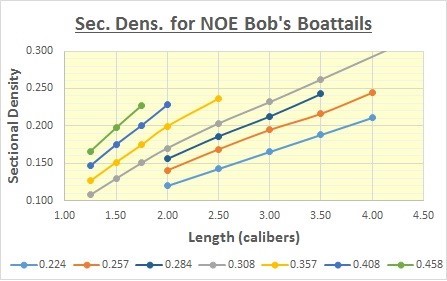
        3600 psi in a 30″ barrel…. SD < 0.25 Other combinations are possible, it is the product of the air pressure and barrel length that sets the practical limit to the SD…. OK, so what are the SDs for various NOE Bob’s Boattails?…. See the graph below…. One thing to note is that there are pretty much three lines of dots horizontally on the graph, at those key SDs of 0.17, 0.21, and 0.25…. NOE-Sectional-Density.jpg

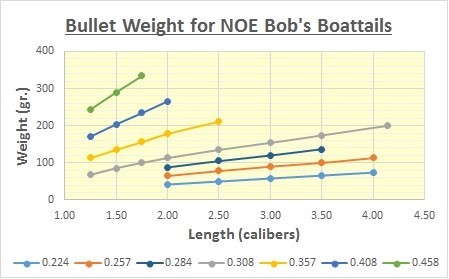
        Start at the SD of your choice and move horizontally in the graph until you get to your caliber…. Then read the Length of the bullet (in calibers) from the bottom axis…. For example, you are interested in an SD of 0.17 in .308 cal…. The bullet that has that SD is 2.00 calibers long…. How heavy is that?…. Next graph….

        NOE-Bullet-Weight.jpg

        This time start at the bottom, with a length of 2.00 calibers, slide up to .308, and look to the left…. That bullet weighs just over 110 gr…. That BBT design is actually the .308 cal 113 gr. FN, or it’s 107 gr. Hollowpoint equivalent…. That is about the heaviest bullet you can expect to drive to about 950 fps with a PCP with a 24″ barrel using 3000 psi…. For reference, my DAQ .308 Exile would hit about 850 fps with that bullet weight, so you can see it’s not easy…. Using a heavier bullet is probably not the way to go….  This should give you a pretty good way to figure out the heaviest bullet that makes sense for your PCP…. In the next post I am going to look at how “slippery” the various Bob’s Boattail designs are….

        Bob

        #500976
        rsterne
        Participant
          Up
          0
          Down
          ::

          So now you have a maximum bullet weight in mind for your gun…. On the design drawings that Al made, there is an estimated Ballistics Coefficient, and it’s associated Form Factor…. What are those, and how do they relate to each other?…. Well, in fact by a simple formula….

          BC = SD / FF

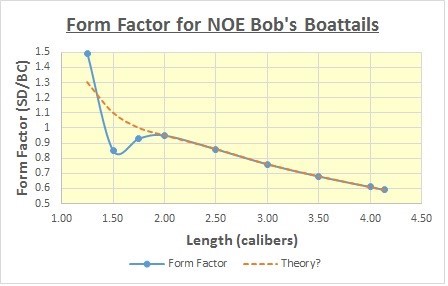
          There are two important things that formula tells you…. 1. that the BC is proportional to the SD, which is basically the weight…. and 2. that the FF is a measure of how “slippery” the bullet is, and that is governed by the shape…. Since my bullets are basically scaled up and down for the appropriate caliber, their FF is basically the same for each Length/Diameter ratio…. Here is a graph showing the Form Factors for the various NOE Bob’s Boattails….

          NOE-Form-Factor.jpg

          The solid line is the averages of the FF’s that Al’s software calculated…. I have no explanation for the “dip” in drag at about 1.5 calibers long, so I added the dotted line which I think is more likely…. Which one is correct is not really critical, the important thing for you to understand is that longer bullets have less drag…. Using the above Form Factors, and dividing them into the Sectional Density for the NOE Bob’s Boattails gives us yet another graph…. This is the approximate BC of all the different designs….

          NOE-Ballistic-Coefficient.jpg

          Within any given caliber, you can clearly see that at the bullet gets longer (and heavier) the BC increases, and it will be less affected by the wind, and will retain its velocity and energy better downrange…. What is really interesting, to me, is that you can see how the BC compares across calibers, for each length/diameter ratio…. The larger the caliber, the higher the SD, so the higher the BC (travelling upwards along each vertical line)…. However, since we are limited by the SD we can use, the advantage in BC for USABLE bullets shifts back in favour of the smaller calibers…. Note that the BC for the Whiteout is just over 0.50, just off the graph !!! ….

          So, that is a summary of the Ballistics Coefficients and how they relate to caliber, weight and length…. The remaining post will deal with the minimum Twist rate for the NOE Bob’s Boattails….

          Bob

          #500977
          rsterne
          Participant
            Up
            0
            Down
            ::

            In this post I will deal with Twist rate…. When we talk about a 10″ or 12″ Twist, we are talking about the distance the bullet has to travel to make one revolution…. What most people don’t realize is that when the twist is originally calculated, it is done in CALIBERS, not inches…. In other words, the twist rate in inches is proportional to the caliber…. Smaller calibers need a faster twist rate, in RPM, to be stable, for the same shape bullet…. To determine the optimum twist rate, I used an online version of the “McGyro” program, again by Robert McCoy…. After determining that, I plotted this graph to show you how the twist rate in calibers is directly related to the length/diameter ratio (and other factors) ie the proportions of the bullet…. I consider the optimum twist rate for an airgun bullet to be the one that achieves a Stability Factor of 1.5 at 1000 fps…. At muzzle velocities below that, or as the bullet slows going downrange, the stability will increase…. If you try and push it to Mach 1, the stability would be marginal, but still about 1.2 (stable, at least I theory)…. The stability of all bullets is worst right at Mach 1…. Here is the graph of recommended twist rates for the NOE Bob’s Boattails….

            NOE-Twist-in-Calibers.jpg

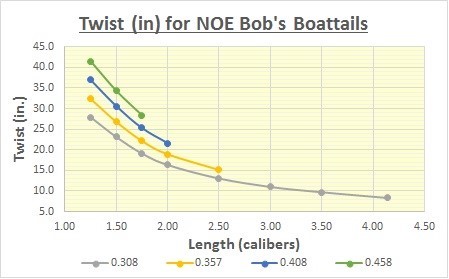
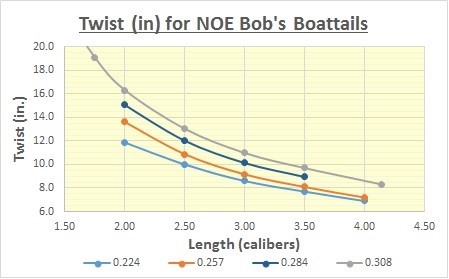
            Note that the caliber isn’t important, it is the proportions of the bullet that determine the twist rate (in calibers)…. Now I realize that this data isn’t very useful for you, so I made two additional graphs, showing the recommended twist rate in inches for each caliber…. I did two graphs because one would have been too crowded to read easily…. First, for calibers .30 and larger….

            NOE-Twist-Large-Calibers.jpg

            Next, for calibers .30 and smaller….

            NOE-Twist-Small-Calibers.jpg

            Before deciding on a bullet, you need to check to make sure that it will be stable in your barrel…. Going back to our example of the .308 cal 113 gr., which has a length/diameter ratio of 2.00, from the above graph it needs about a 16.3″ twist…. Therefore, any barrel 16″ twist or faster should work just fine…. This doesn’t mean if won’t work in an 18″ twist…. just that if you push it too fast (too close to Mach 1) you may have a problem….

            One thing I should note…. Some of my Bob’s Boattails require a surprisingly fast twist…. Part of that is because they are boattails, the same thing that makes the bullet have less drag (by acting longer than it is) also make it less stable (for the same reason)…. So, they have to be spun up faster than the same length bullet with a flat base…. In most cases you will be able to find a barrel with a fast enough twist, but for the longest BBT designs (those that are 4 calibers long) it could be a problem…. The .308 cal was chosen for the Whiteout because it is the caliber where you can buy particularly fast twist barrels…. it uses an 8″ twist….

            I hope that this series of posts has given you some insight into my designs, why they are done the way they are, and how to choose a good one for your airgun…. Rather than ask questions about a specific bullet in this thread, I would request that you do it in the thread for that individual bullet…. I would be happy to offer my opinion on the suitability of any of my designs for any specific platform…. Thanks for your attention, and Good Luck….

            Bob

          Viewing 3 replies - 1 through 3 (of 3 total)
          • The topic ‘Bob’s Boattails’ is closed to new replies.