
- This topic is empty.
-
Topic
-
rsterne
I found some time today to cast some of the new .22 cal Bob’s Boattails from NOE…. I used 1% tin in pure lead, and a temperature of about 840*F because of the tiny size of these bullets…. I have found the smaller the bullet, the hotter the temperature the lead needs to be, to properly fill out the mould…. They looked pretty good while I was casting them, no wrinkles on the body, but when it came time to sort them I found that over 2/3rds of the HollowPoints had a couple of small wrinkles so that the nose was not perfect…. Since some were fine, this is not a mould problem, but not quite enough temperature in the melt…. probably another 10*F would have made most of them perfect…. Alternately, a bit more tin might make the difference, but at over 800*F, the tin tends to burn out of the alloy, so just more heat might be the best answer…. Here are what they look like….

If you look at the HP on the upper right, you can see a couple of small divots in the HP rim…. compared to the perfect HP on the upper left…. In two hours of actual casting time (not including setup, melting the lead, and preheating the mould) I cast about 600 bullets, half were solids and the other half HPs…. Here is a photo of them….
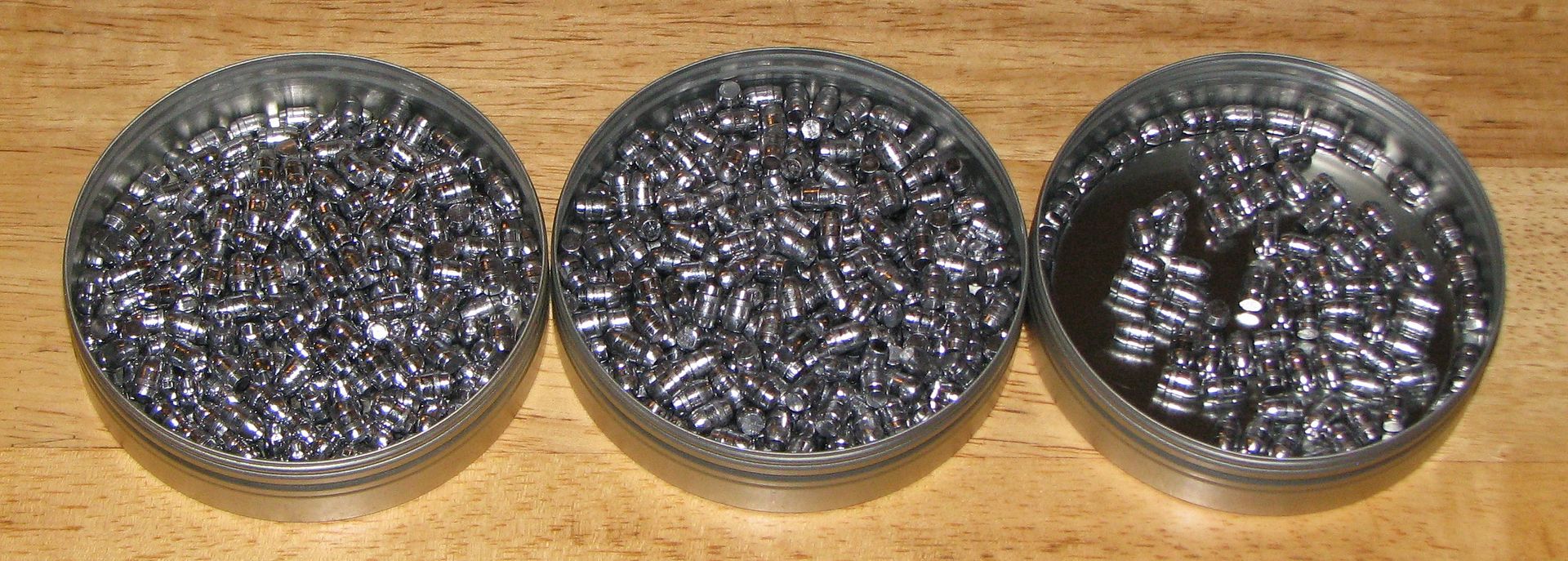
The 2nd quality HPs are on the left (over 200), the solids are in the middle (nearly 300), and the perfect HPs are on the right (about 90)…. The solids weighed 29.6 gr. in this alloy, and the HPs were 27.4 gr…. and you couldn’t weigh any diference between the perfect ones and the seconds…. so I can use the seconds for Chrono testing and possibly target work, depending on how accurate they are, and I will save the first quality HPs for hunting…. As cast, the bullets were very close to the design size, which was 0.217″ at the back of the nose, 0.211″ in the middle, and 0.219″ at the rear band…. They were pretty good for being round, within about 0.0005″, and the diameters varied about 0.0005″ from bullet to bullet, just due to temperature and technique I am sure…. That’s what sizing dies are for, right?…. Here are photos of the beautiful NOE Moulds….
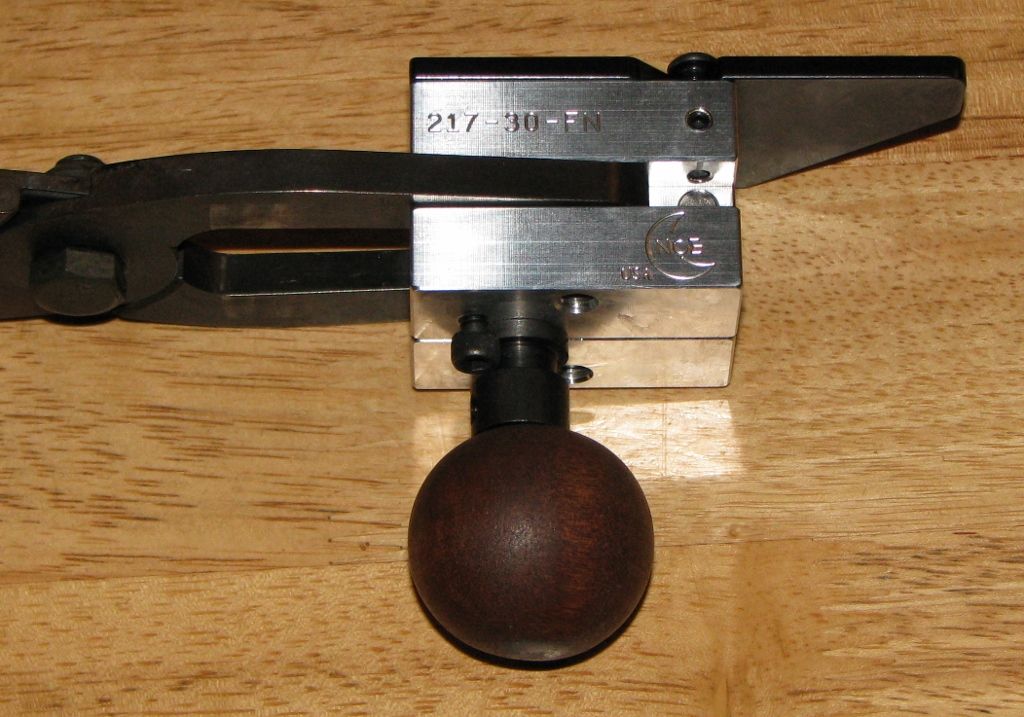
There is a Lyman style HP pin in one cavity, and this mould is for the smaller size that is available…. The larger one is 0.220″/0.222″…. ie 0.003″ larger in diameter…. Post continued below….
 rsterne


 denisbeaudry
 ( Thanks Bob) I used the 400 grit sand paper technique ,and I use the term technique loosesly . The process didn’t take too long ,using 400 then 800 then 1500 grits to smoothen the transition out. I sized them to .2195″and they seem to chamber nicely with little force. I pushed a few out after being chambered and he riffling marks are consistent , riffling on the nose , none in the centre portion and slight markings on the rear band . Just for a secondary check I pushed a few JSB pellets with 5.52 mm on the tin , they had slight marks on the nose and none on the tail . Looks like I’ll need to go shooting and see how they work .
  kirbyolsen


- You must be logged in to reply to this topic.