::
When I cut a chamber for a bullet, I make the parallel section of the chamber 0.001-0.002″ larger than the groove diameter of the barrel…. This holds the bullet straight while guiding it into the leade…. I make the leade with a 1 deg. taper per side, and the front of the taper on the reamer stops well below the land diameter…. In front of that I have a pilot section on the reamer, which has no cutting flutes cut into it, and it is 0.001-0.002″ smaller than the land diameter…. Here is a sample of one of my homemade 3-flute chambering reamers that has been used to cut a chamber….
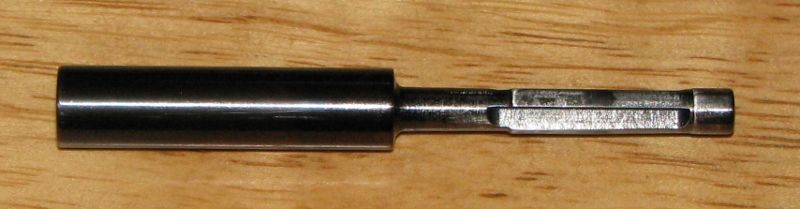
About the middle of the flute you can see a dark, shiny area…. That is the only part of the reamer that actually does any cutting, and is the actual leade…. Forward of that (to the right) the taper is smaller than the lands, and behind that the reamer is parallel and serves only to smooth the chamber and keep the reamer straight…. Behind the chamber the diameter is cut away to allow chips (actually just a fine dust) to escape….
When I am cutting the chamber, I cut slowly deeper, and keep checking where a bullet (sized to groove diameter) stops when it is just touching the leade…. When the back of the bullet is about in the middle of the barrel port, I then push it forward until the resistance feels too high…. This usually occurs when the front drive band is starting to engage the full depth of the rifling, at the front of the leade, but depends a lot on bullet shape…. I keep cutting the chamber deeper until the back of the bullet can be pushed just forward of the front of the barrel port without excessive effort…. Usually there are no marks at all on the rear driving band, because if you try and force the bullet that deep, you have to push way too hard on the bolt…. Here are some bullets I used when cutting a chamber in a .257 today….

The long bullets on the left show considerable engagement in the rifling, not quite full depth, but that is because they do not have a parallel band, the ogive tapers all the way to the step at the back of the head…. The shortest bullet on the right shows NO marks, and the chamber is a bit too long to be ideal with that bullet, although you can JUST feel it touch the leade when loading…. The four other bullets have some resistance for the last 0.06-0.10″ as they engage the start of the leade…. This was an unusual chamber, because I was trying to get a large variation of bullets to fit…. Below is a better example of a chamber cut for both pellets and bullets….
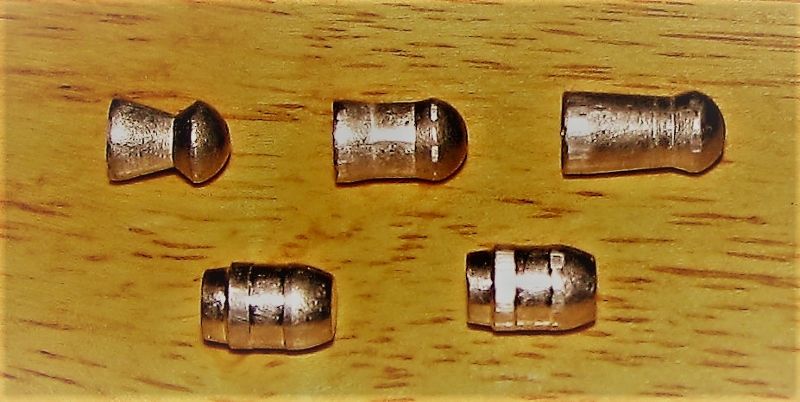
The bullet on the lower left has not been chambered, the one beside it has been…. You can see nearly full depth rifling engagement on the back of the head, and slight marks on the rear driving band…. The three pellets in the top row show no marks on the skirt, it rides only in the parallel section of the chamber…. but show pretty much full rifling engagement on the back of the head…. This is exactly what I am looking for when I chamber a barrel….
If you have such a short chamber that the rear drive band is engaged, you will likely find it difficult to impossible to close the bolt, unless you size the bullets a lot smaller than the groove diameter, so that the lands do not have to displace too much lead…. at least that has been my experience….
Bob

denisbeaudry
 denisbeaudry
 rsterne

