
Home › Forums › NOE Forums › NOE Archive › Historical Archive › Using NOE Moulds › At the Range › Breaking 3K with the NOE XCB bullet
- This topic is empty.
-
CreatorTopic
-
2014-12-22 at 01:14 #487777
bjornborud
Participant::I finally found time to shoot my 30 XCB rifle today, bringing along several loads that I had prepped after last week’s outing. Today I was going to shoot ball powders, both Hodgdon LeveRevolution (LvR) and Winchester 760 have given higher velocities compared to extruded powders in earlier trials. All HV shooting today was done using Tim Malcolm’s breech seater, as max powder capacity and highest possible MV was the goal. To recap, my 30 XCB rifle is a target rifle from the 1950s, built on an FN Mauser blind single shot action. The barrel is a new Shilen Match, 31 inches long, 1 in 14 twist. Tim Malcolm (Goodsteel) recently re-barreled and re-bedded the rifle.
I had devised a “ladder test” of sorts, to figure out at which MV the bullet/lube/powder charge combo would lose accuracy. Not to be confused with the Creighton Audette ladder test, this was simply a series of charges starting at a known level, increasing by 2 grains per charge for the LvR and 1 grain per charge for the W760. Here are the targets for these 2 “ladders”:
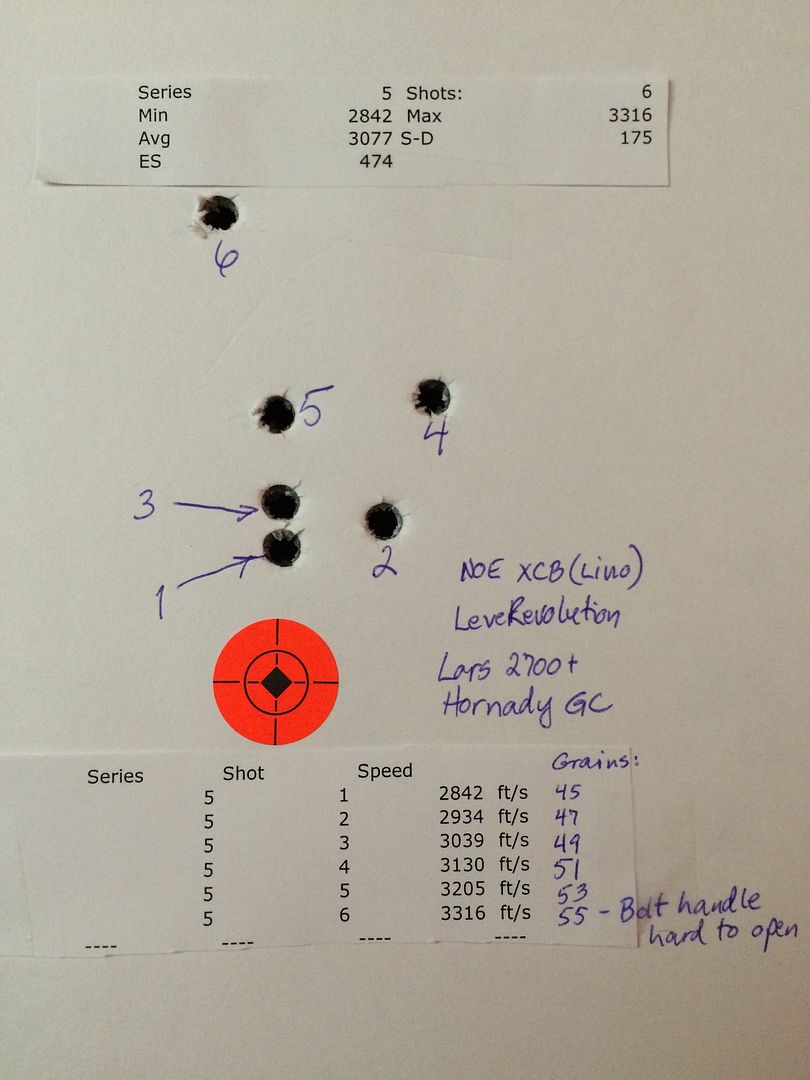
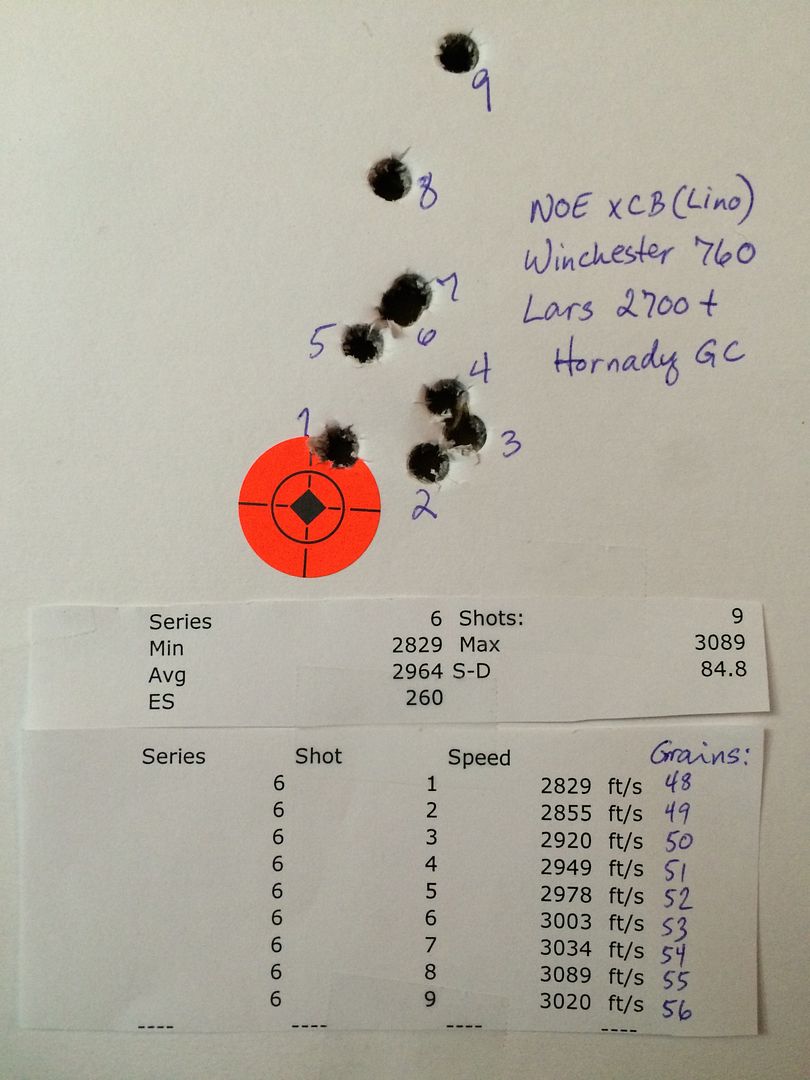
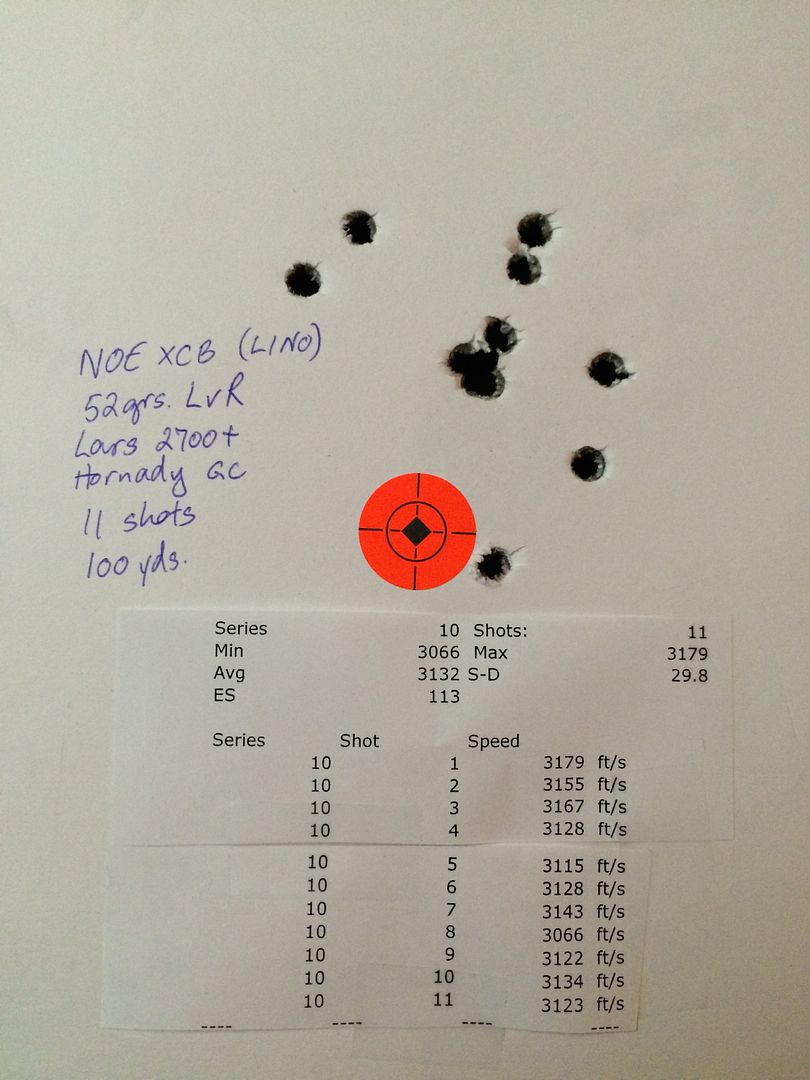
At this point I picked one charge from each “ladder” and shot a 10-shot group of each. I picked charges that I believed would stay together:
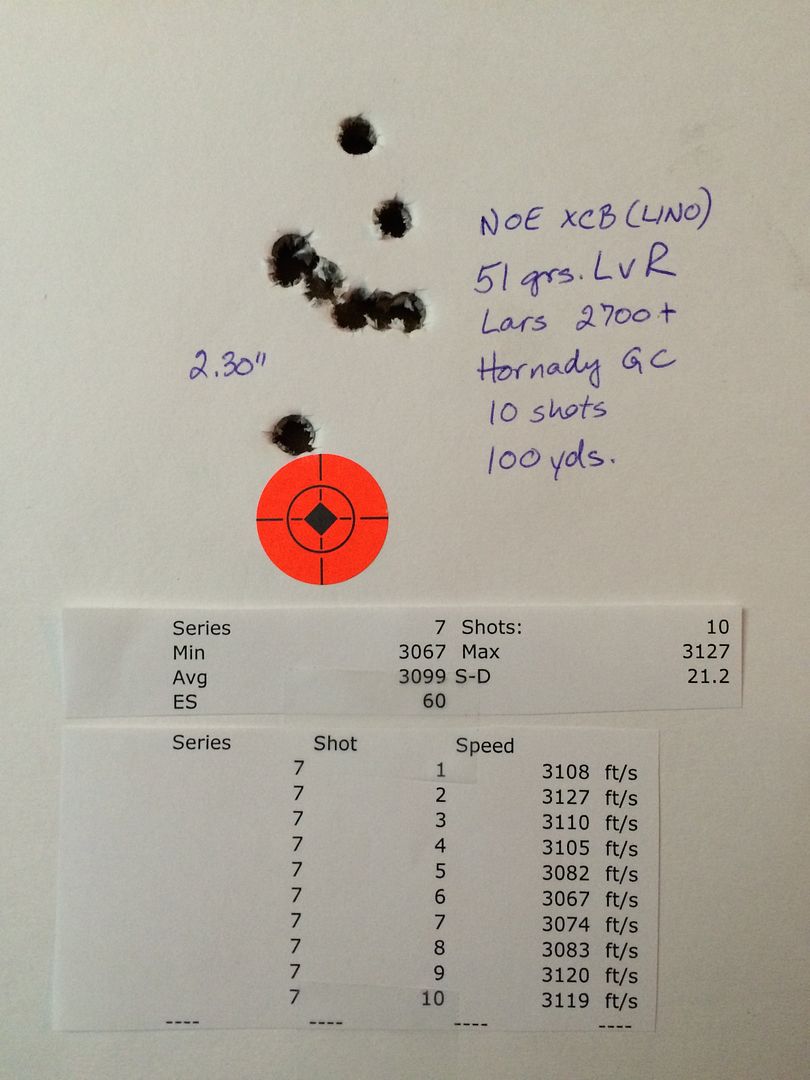
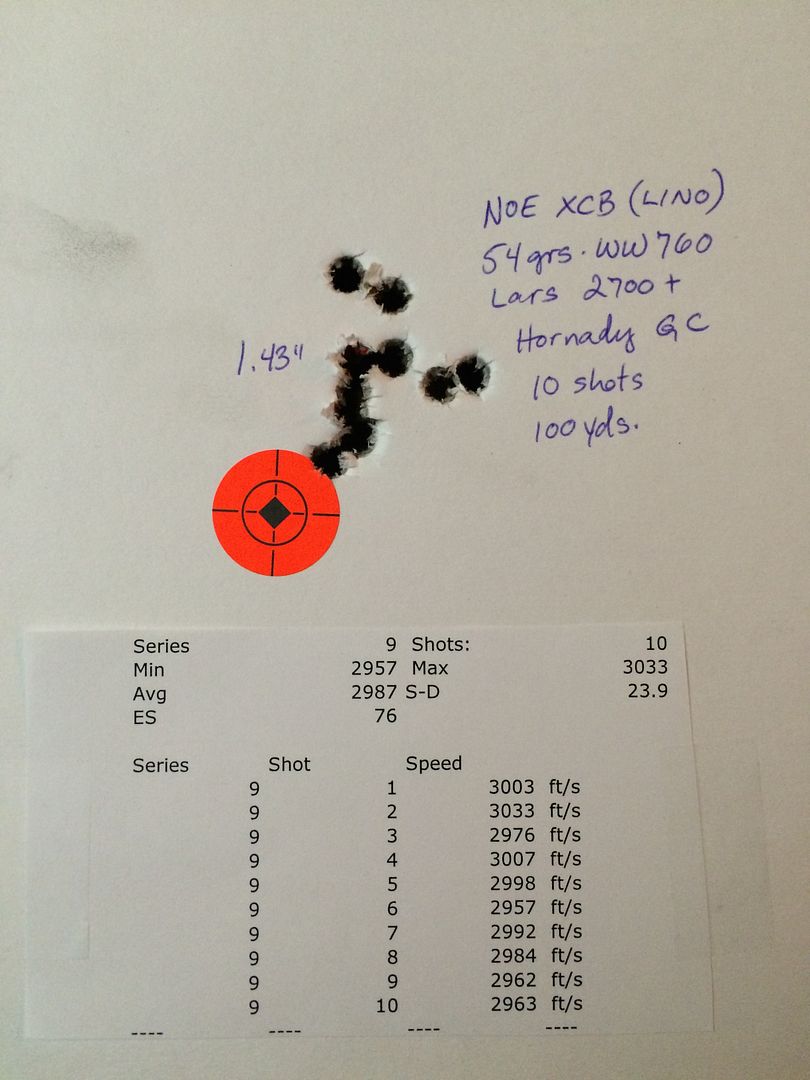
Finally I upped the charge of the LvR powder by one grain and shot another group. This turned out to be where accuracy went south:
I did not bother to measure this group.
I have to say that this outing was very encouraging, and it certainly proved to me that the NOE 310-165 FN (XCB) is an outstanding bullet, and that White Label 2700+ Carnauba Red is an outstanding lube.
With this shooting I consider myself done with the breech seater, I’m sending it to Larry Gibson in Arizona so he can use it with his Oehler Ballistics Lab to plot the pressure curves in some of these loads. After the 55 grain load of LvR today (MV 3316 fps) the bolt handle was hard to open and I didn’t increase the powder charge any further. Primers were starting to flatten, but I have seen them much worse on heavy jacketed loads. -
CreatorTopic
 bjornborud
-
AuthorReplies
-
2014-12-23 at 20:13 #494974Participant::
Hello Guys,
I don’t understand why lino produces a more accurate boolit than #2. I get that it is harder from the increased antimony and lighter in weight (slightly) but the 5% tin in #2 provides excellent fill out.So why is lino more accurate and weight consistent?
Thanks,
JeffI have no clue Jeff. I switched to Lino and it shot better than #2 alloy. For me. I’ll be switching back to water dropped #2 just to see what happens. I don’t know how many times I have read or been told that each rifle is different as to what she likes, but I only post my results and those are the results.
2014-12-23 at 21:24 #494975frankelliott
Participant::Hello Guys,
I don’t understand why lino produces a more accurate boolit than #2. I get that it is harder from the increased antimony and lighter in weight (slightly) but the 5% tin in #2 provides excellent fill out.So why is lino more accurate and weight consistent?
Thanks,
JeffCBA shooters have been using straight lino for many years and most of the winners and record holders use it.
There is only 1% tin difference between #2 and lino, not enough to effect fill out.
Lino is basically 22 bhn and #2 (depending what formula you use) is 15 – 16 bhn, Lino is usefully harder.
As to comments on Bjorn (got it right this time
 ) results, I’m not supprised, no one has experiance at that velocity and w/o knowledge, it’s hard to make comments, other that to say have you tried this or that or you should try this.
Breech seating has been around since the 1880’s, that’s not new but, using it in bolt actions is, although a Bev Pinney of BC, Canada, has BSed his bolt action rifle in CBA matches for at least 5+ years with PB bullets. It is the key to accuracy and it seems that in HV accuracy, it’s extremely useful.
Frank
2014-12-23 at 21:41 #494976sgt.mike
::Hello Guys,
I don’t understand why lino produces a more accurate boolit than #2. I get that it is harder from the increased antimony and lighter in weight (slightly) but the 5% tin in #2 provides excellent fill out.So why is lino more accurate and weight consistent?
Thanks,
JeffJeff
Frank hit quite a bit of it in his post harder alloy, the Breech seater is another reason Bjornb is enjoying success .
The Breech seater minimizes the damage to the base of the gas check or bullet base in the case of a Plain based bullet versus the force of the charge in the cartridge case. Goodsteel did quite a bit of experimenting with bullet base damage a while back on the Cast Bullets Forum. when Bjorn and Goodsteel was initally talking about this I did not think they would get to this level of success.Hopefully this answers your questions. BTW Bjornb has more to do in this endeavour but Ill let him spring that on yall
Thanks for your time
Mike2014-12-23 at 22:19 #494977Participant::Hello Guys,
I don’t understand why lino produces a more accurate boolit than #2. I get that it is harder from the increased antimony and lighter in weight (slightly) but the 5% tin in #2 provides excellent fill out.So why is lino more accurate and weight consistent?
Thanks,
JeffCBA shooters have been using straight lino for many years and most of the winners and record holders use it.
There is only 1% tin difference between #2 and lino, not enough to effect fill out.
Lino is basically 22 bhn and #2 (depending what formula you use) is 15 – 16 bhn, Lino is usefully harder.
As to comments on Bjorn (got it right this time
) results, I’m not supprised, no one has experiance at that velocity and w/o knowledge, it’s hard to make comments, other that to say have you tried this or that or you should try this.Breech seating have been around since the 1880’s, that’s not new but, using it in bolt actions is, although a Bev Pinney has BSed his bolt action rifle for at least 5+ years with PB bullets. It is the key to accuracy and it seems that in HV accuracy, it’s extremely useful.
Frank
Very good points Frank. And for the record, I’m not looking for any accolades. I’m thrilled that the cartridge/bullet/alloy/lube/powder combos we have picked have worked so well, and I’m sharing the results for those (probably very few) who would like to try the same shooting. I see NO reason why we should have to fight over this. If someone thinks we are ignorant, that our accuracy (2 MOA) isn’t real accuracy, that we live in some kind of fantasy Dome (this was from a guy who averages one post per week on his forum, and only when he posts it himself), all I can say is that you ignore us totally while you go on with what’s important to YOU.
I was talking to Tim and Sgt. Mike today regarding the usefulness of Linotype for hunting (it’s generally considered too brittle, Larry also made that comment to me a while back), and we decided to conduct some experiments with Lino fired at HV into some wet phone books just to check the terminal performance. It is of some importance that this kind of shooting can be translated into the hunting world, as we are talking about regular factory velocities in 308 Win here.
2014-12-23 at 23:45 #494978Larry Gibson
::Hello Guys,
I don’t understand why lino produces a more accurate boolit than #2. I get that it is harder from the increased antimony and lighter in weight (slightly) but the 5% tin in #2 provides excellent fill out.So why is lino more accurate and weight consistent?
Thanks,
JeffJeff
Linotype produces the less shrinkage of the 2 alloys. The less the shrinkage the more uniform the bullet will be. The more uniform the bullet the better balanced. The better balanced the bullet the easier and more consistently balanced it can be launched. All of which gives better accuracy.
I pretty much limited out accuracy wise in my 14″ twist .308W Palma rifle at 2700 fps with #2 alloy with seated 30 XCB bullets. Breach seating would probably increase that and so would using linotype alloy. However that was not my own goal to achieve. I have consistently stuck with #2 alloy because I want to see how far it can be pushed. Once that is accomplished I will then switch alloys to see where that takes me. The problem with these tests is the pundits want/think you should change the test criteria mid stream in the test to suit their fancy or ideas. I’ve chased that tale too many times. I will stick with the original criteria until it plays out and then try something else.
Right now BjornB has done an excellent job of pushing linotype 30 XCBs to 3000+ fps with BS’d bullets. He wants to try seated bullets next which is fine. It will be interesting to see the difference the seating and lessor capacity with the bullets seated in the 30 XCB cartridge make. I’m pretty much done testing with the 14″ twist .308W now. I am limited by case capacity. My next step with the #2 alloy cast 30 XCB bullets in the 30″+ barrel with 16″ twist chambered in the 30×60 (30 XCB reamer run deeper for 54/55 gr capacity). That should give the 30 XCB bullet 3000+ fps also. I will first test with #2 alloy and then switch to linotype myself.
Larry Gibson
2014-12-24 at 00:56 #494979rickkelter
::bjornb, quite fascinating for sure. It will be quite the experiment when comparing breech seated vs. normal seating, I’ll not be building a bench gun and pretty unlikely I’ll do any breech seating so the grouping results with conventional seating will be a most interesting comparison. Sounds logical that breech seating is an aid but how much?
I never doubted you would get to 2750 or so with accuracy but 3000+. Wow, impressive doesn’t describe it.
Rick
2014-12-24 at 14:27 #494980suemunger
::Congratulations on your work with HV. Dedicated researchers conducting real world tests advance our hobby. I will be following all of your efforts. I doubt I will follow you down the rabbit hole as I shoot cast for the reduced recoil and the majority of my reloads are fired at steel targets, and velocity above 1,800 fps causes cratering.
My issues notwithstanding, I’m certain I will learn something and maybe I’ll even melt up some of my 40 year stock pile of lino, that I currently don’t use.Duke
2014-12-24 at 17:33 #494981richardshedd
2014-12-24 at 17:36 #494982daveridenour
Participant2014-12-24 at 17:56 #494983JRR
::Thanks Guys for my continuing education.
My most accurate 8 mm is the BRP 200 sil. The XCB bullet seems to also be incredibly accurate. What they both have in common is the lack of a demarcation or ersatz crimp groove dividing the nose dimensions from the main body.
My thought is that so many designs use this groove to create a clean circumference that is not as affected by casting irregularities. The lack of this groove with hard alloy should improve hunting performance by reducing cracking and breaking at this stress riser.
What are some thoughts about this design in the quest of accuracy?
 2014-12-24 at 18:32 #4949842014-12-24 at 19:13 #494985
ianharris
::Hello Guys,
I don’t understand why lino produces a more accurate boolit than #2. I get that it is harder from the increased antimony and lighter in weight (slightly) but the 5% tin in #2 provides excellent fill out.So why is lino more accurate and weight consistent?
Thanks,
JeffJeff
Linotype produces the less shrinkage of the 2 alloys. The less the shrinkage the more uniform the bullet will be. The more uniform the bullet the better balanced. The better balanced the bullet the easier and more consistently balanced it can be launched. All of which gives better accuracy.
I pretty much limited out accuracy wise in my 14″ twist .308W Palma rifle at 2700 fps with #2 alloy with seated 30 XCB bullets. Breach seating would probably increase that and so would using linotype alloy. However that was not my own goal to achieve. I have consistently stuck with #2 alloy because I want to see how far it can be pushed. Once that is accomplished I will then switch alloys to see where that takes me. The problem with these tests is the pundits want/think you should change the test criteria mid stream in the test to suit their fancy or ideas. I’ve chased that tale too many times. I will stick with the original criteria until it plays out and then try something else.
Right now BjornB has done an excellent job of pushing linotype 30 XCBs to 3000+ fps with BS’d bullets. He wants to try seated bullets next which is fine. It will be interesting to see the difference the seating and lessor capacity with the bullets seated in the 30 XCB cartridge make. I’m pretty much done testing with the 14″ twist .308W now. I am limited by case capacity. My next step with the #2 alloy cast 30 XCB bullets in the 30″+ barrel with 16″ twist chambered in the 30×60 (30 XCB reamer run deeper for 54/55 gr capacity). That should give the 30 XCB bullet 3000+ fps also. I will first test with #2 alloy and then switch to linotype myself.
Larry Gibson
I’d like to submit the humble paper-jacketed, straight-air-cooled-wheel-weight bullet, shot as-cast and unsized from a custom mould, achieving repeatable, round groups of under an inch at over 2700 fps. Also, another person sizes standard .311″ bullets of similar alloy in a push-through and shoots them to 3,000 fps, again with sub-moa accuracy. I don’t think deformation from shrinkage (or lack therof) causing balance issues has much to do with it, but grain structure most likely DOES. All the testing that you and Bjorn have been doing actually generates a lot more useful data than just groups, velocities, and powder charges, all of it is appreciated.
I do have some reservations about the “pundits” comment, though, for this cartridge was actually brought to fruition by four people interested in testing a variety of things, many of which did not have any pre-conceived parameters for the results. Personally, my accuracy standard was considerably less than an inch, at 2500 fps, with a soft hunting bullet in the 180-grain range. I don’t expect anyone else to have that same goal. Pushing a 165-grain bullet to over 3100 fps in an extra-long barrel probably has never been done before and is very cool in and of itself, certainly no criticism from me. I’d bet that if the bullets Bjorn was breech-seating were pushed right at 3050 fps with the WW760 and the bore patched between shots the flyers would have gone away and he’d be well under an inch, which is dang fantastic, I don’t care who you are. One of the points discussed in later development (reamer design) was how versatile the cartridge ought to be, considering the capability of the “parent” and some of the cast-bullet-specific improvements that were made. Options and capabilities make this a really useful platform for learning.
Bjorn: One thing that does concern me with the breech seating is throat erosion. Normally the bullet buffers the fire and initial kernel blast from reaching the throat….but you are making the throat and neck part of the chamber itself. I wonder how quickly the edge of the throat will round off and if the throat angle will change shape….keep an eye on it.
Gear
2014-12-24 at 19:16 #494986::My thoughts on the lack of a “shoulder” going to full diameter is it is something less to be damaged going into the rifling/leade.
More bearing surface with less sharp edges to be sheared/squished/scraped is a good thing to me.
But…..some of the Silhouette designs with a crimp groove have been shooting as well or better than similar designs without the crimp groove for many years. Probably one of those “depends” things. So few clear “rules” with cast bullets.
Gear
2014-12-24 at 19:22 #494987::My thoughts on the lack of a “shoulder” going to full diameter is it is something less to be damaged going into the rifling/leade.
More bearing surface with less sharp edges to be sheared/squished/scraped is a good thing to me.
But…..some of the Silhouette designs with a crimp groove have been shooting as well or better than similar designs without the crimp groove for many years. Probably one of those “depends” things. So few clear “rules” with cast bullets.
Gear
At what speeds? I know the Silhouette designs have shot accurately, but it is usually slower speeds. This thread is about high velocity so where may I read the threads of the silhouette designs shooting accurately at 2500+ FPS?
2014-12-24 at 19:51 #494988 -
AuthorReplies
 frankelliott
 sgt.mike
 Larry Gibson
 rickkelter
 suemunger
 richardshedd
 daveridenour
 JRR
 ianharris
 Mike Bambauer

- You must be logged in to reply to this topic.