
Home › Forums › NOE Forums › NOE Archive › Historical Archive › Group Buys › Group Buy Discussions › Enfield Pritchett bullets
- This topic is empty.
-
CreatorTopic
-
2015-02-26 at 16:47 #487904
adamsutherland
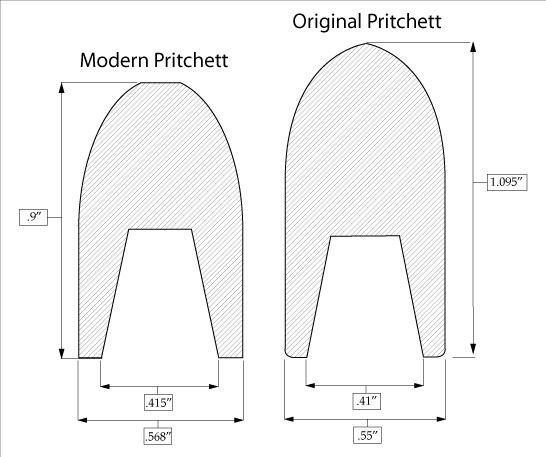
Moderator::OK seeing as how I’m on a muzzle loading roll along with the Gardener bullet I also like a good mould of the original Enfield Pritchett bullet.
This drawing was done for/by Oyvind Flatnes when he had a Lee special order mould cut for the Modern Pritchett he designed, I have one of these no longer available moulds and the short bullet works well in the slow twist P53s especially at the shorter ranges.
I would like to see a mould of each the long original and the newer modern Pritchett.
Any one else shoot 577 rifled musket, Britain supplied a substantial amount of these rifle to the North and the South during the American Civil War so surely there has to be some of you shooting these fine firearms.
-
CreatorTopic
 adamsutherland
-
AuthorReplies
-
2015-06-22 at 13:23 #496972
SwedeNelson
Keymaster2015-06-22 at 22:30 #496973Scotsman13a
::1/2″ would likely be too thick for a baseplug. 1/4″ would be close to ideal. There existed only one device for casting baseplugs that I’ve ever seen. It was intended to use automotive body filler. I have a picture or two I’ll try to post. I do not know what the dimensions of the finished plug as cast should be, though. I thought I remember reading the originals were .001″ undersized of the skirt. It seems to me it should be slightly larger than the skirt, though. I could be wrong, and hopefully someone with more knowledge of that than I have will chime in.
Also, you’ve lost me. I don’t know what a Lyman vs. RG type mold would be. Nor am I entirely sure I need or could afford a 4 cavity mould, let alone 2 of them. Are we talking about the ability still to cast a bullet of either diameter, given 2 different diameter molds, and be able to change the skirt depth and/or bullet length? Sorry if I’m not quite following along now. I’m afraid we’ve exceeded my brainpower regarding bullet molds!
Here is the only picture I could find of a device to cast baseplugs, and an original Pritchett with plug. The mold picture was made by someone around which much drama occurred, apparently, and it’s no longer available. But it evidently worked well for the few people who got one. Something similar would likely be quite satisfactory.
2015-06-22 at 22:37 #496974christopherharding
2015-06-22 at 22:50 #496975Keymaster2015-06-23 at 03:09 #496976garyaardahl
2015-06-23 at 05:37 #496977Moderator::I would like the base plug mould to be 0.225″ deep and 0.030″ over base cavity size.
This is for clay plugs and the shrinkage allows the plug to sit 0.040″ proud of the base of the bullet which I have found to be best in Minies.
I haven’t tried with bodge so not sure about shrinkage for that.
I will be trying beeswax soaked fired clay plugs in some 0.564″ Pritchetts today and will report back, they are sitting 0.040 proud and the paper rolls and chokes just fine around it.
2015-06-23 at 07:29 #496978Moderator2015-06-23 at 08:16 #496979::Rather surprised you have one as shown in the photo. One can’t seem to mention the name of the place that once sold them without people crawling out of the woodwork to tell stories of how this guy ripped them off, stole their money, stopped answering their phone calls, etc. Rather glad I didn’t try to order one from him. Seems the odds would have been stacked against me. You make the third person to tell of actually getting your order from him, that I know of.
Don’t know the shrinkage of automotive body filler. Just read some boards that some of the folks who make their own baseplugs seem to think it’s quite the right substance for baseplugs, authenticity notwithstanding, of course. I wouldn’t know the first thing regarding what manner of clay be used. Casting slip? Air-dry? Polymer type? What kind would one use?
2015-06-23 at 09:32 #496980lwatson
Participant2015-06-23 at 15:15 #496981Moderator::Rather surprised you have one as shown in the photo. One can’t seem to mention the name of the place that once sold them without people crawling out of the woodwork to tell stories of how this guy ripped them off, stole their money, stopped answering their phone calls, etc. Rather glad I didn’t try to order one from him. Seems the odds would have been stacked against me. You make the third person to tell of actually getting your order from him, that I know of.
Don’t know the shrinkage of automotive body filler. Just read some boards that some of the folks who make their own baseplugs seem to think it’s quite the right substance for baseplugs, authenticity notwithstanding, of course. I wouldn’t know the first thing regarding what manner of clay be used. Casting slip? Air-dry? Polymer type? What kind would one use?
Regarding the plug mould I didn’t get it from Coyote as my order was one of the ones caught up when he went off the rails, a generous anonymous benefactor came forward and funded the Coyote rescue project which ensured that some of us got what we had paid for.
The clay I use is whatever my wife has in, this current batch was stoneware clay fired to 750 degrees.
The test cartridges today were not successful but I have put this down to the base of the paper wrapper sticking to the base of the plug as there were no paper bases to be found in front of the firing point as there usually are, just the side petals were sheding.
I put some of the plugs in the bases of some RCBS Minies I had and they shot just fine with the usual nice tight groups so will put some cartridges up for next week without deep frying them in bees wax and see how that goes.
2015-06-23 at 19:34 #496982::Aha. See, that’s what worries me. I haven’t got a kiln to fire any clay. Maybe that’s why auto putty caught on? I don’t know. I’m hoping some form of air dry clay works, or auto filler, or JB weld, or something. May fall into the “close enough is good enough” column for me. But of course, I’d rather do it well if possible, but it may not be possible if I need access to a kiln.
2015-06-24 at 21:06 #496983robertcrisman
::I’ve been following this discussion with interest since Dromia posted a link to this board on the British Militaria Forum. I do want a Prtchett mould but I’m a bit confused whether the plan is for single cavity moulds in each diameter or a double cavity mould with 2 diameters or . . . .
As for plug material, one option might be Crayola Air Dry Clay. I haven’t used it so I don’t know how viable it would be.
2015-06-25 at 00:56 #496984::I’ve been following this discussion with interest since Dromia posted a link to this board on the British Militaria Forum. I do want a Prtchett mould but I’m a bit confused whether the plan is for single cavity moulds in each diameter or a double cavity mould with 2 diameters or . . . .
As for plug material, one option might be Crayola Air Dry Clay. I haven’t used it so I don’t know how viable it would be.
Yeah, I’m a bit worried about that myself. I’m no longer sure what these moulds may be at this point. A couple single cavity moulds, possibly with the ability to change skirt depths was all I was after. Well, that and a baseplug mold, depending on cost. Hopefully there’ll be some clarification soon.
Don’t know about the Crayola clay. Never heard of it before, but it looks to be fairly inexpensive, so it would be great if that were suitable.
2015-06-25 at 06:46 #496985Moderator::There will be a mould for each diameter, NOE doesn’t mix diameters in a single block number of cavities will be your choice, RG moulds use interchangeable captive base pins with will control length of bullet, cavity depth and profile.
Do search on here for more detail on RG type moulds and the style of NOE moulds in general.
Here is one thread explaining them with photos.
2015-06-25 at 07:01 #496986Moderator::I have tried making plugs bodge and JB weld in th past but found it messy so prefer clay as I find it easier to work with.
Why don’t you make up some base plugs with the stuff using say the base cavity in an ordinary Minie as a mould and measure the shrinkage. I suspect that it will be less than clay.
-
AuthorReplies
 SwedeNelson
 Scotsman13a
 christopherharding
 garyaardahl
 lwatson
 robertcrisman
- You must be logged in to reply to this topic.