::
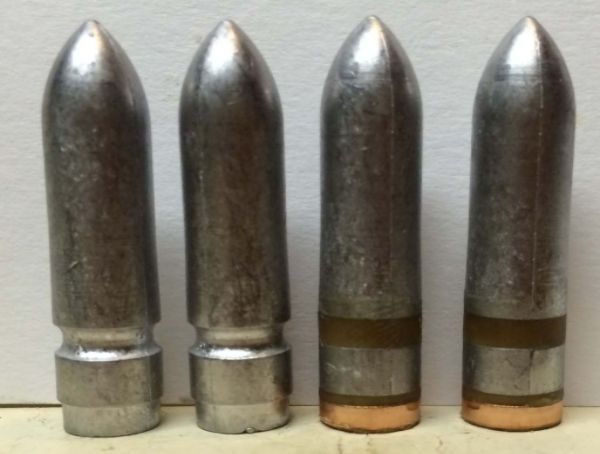
Couple of thoughts here. John Ardito, who I understand designed that bullet, was far less concerned with BC than with accuracy. My Lyman version was terribly undersized and out of round, I re-aligned the blocks and knurled the cavity faces to make it round….and it casts .300″ exactly on the nose from ogive break back about 3/8″. The main portion of the nose is exactly parallel, the drawing presented here is far better as it indicates a shallow taper transitioning to a steeper one, which is a well-proven design. What will be an issue for many people is the .300″ dimension being so far out toward the tip of the nose. Many rifles will not accept a bullet that is even 1/2 thousandth larger than bore diameter without pushing it back into the case. Without exception, I have found NOE moulds to cast at least that much and up to .002″ larger than the drawing indicated with common WW alloy and no additional tin. If the mould is made and casts .301″ or larger on the nose (adding any tin makes the issue worse) this bullet will be useless in all but the most worn and largest-bore rifles. If the rifle will accept the bullet at .301″ or larger due to wear, it will likely leave most of the middle of the bullet’s nose unsupported due to the common throat wear pattern of .30-caliber rifles.
What I would like to see is the nose dimension at the trailing edge of the ogive reduced to .299″. This would ensure adequate ease of chambering with most rifles and alloys that will be used, and also increase the more oblique nose angle slightly, which could also be an advantage to both BC and accuracy. Reducing the nose size would practically be a requirement for autoloading rifles. I have an M1A, three .308’s with various chambers, and two .300 BLK rifles and NONE of them will accept anything larger than .300″ past the end of the throat taper.
If I were to keep wishing, I would also like to see a crimp groove located so the rear of the “band” in front of the crimp groove is about .850″ back from the tip of the nose for .300 BLK, but then that might call for a new mould number.
Gear

Elkins45
 Elkins45
 barrywgoodwin
 stevendragonjr
 mattazelton
 ianharris
 SwedeNelson
