Shooting the 310-165-FN (XCB), some observations

Home Forums NOE Forums NOE Archive Historical Archive Using NOE Moulds At the Range Shooting the 310-165-FN (XCB), some observations

  • This topic is empty.
  • Creator
    Topic
  • #487751
    bjornborud
    Participant
      Up
      0
      Down
      ::

      I shot 160 rounds loaded with the XCB bullet today, giving my XCB rifle a good workout. What I was doing was in no way a TEST, in fact I won’t be using that word much anymore, since a test implies laying down baselines, using a comparison protocol, a minimum amount of shots, etc. etc.

      Rather than getting all complicated I’ll be doing some shooting, explaining and observing over the next few months, and I invite you shooters out there to share your comments and critiques here on the board. No “rights” or “wrongs”, I’ll be trying out a multitude of variables in my quest to make my rifle shoot as well as she is capable of.

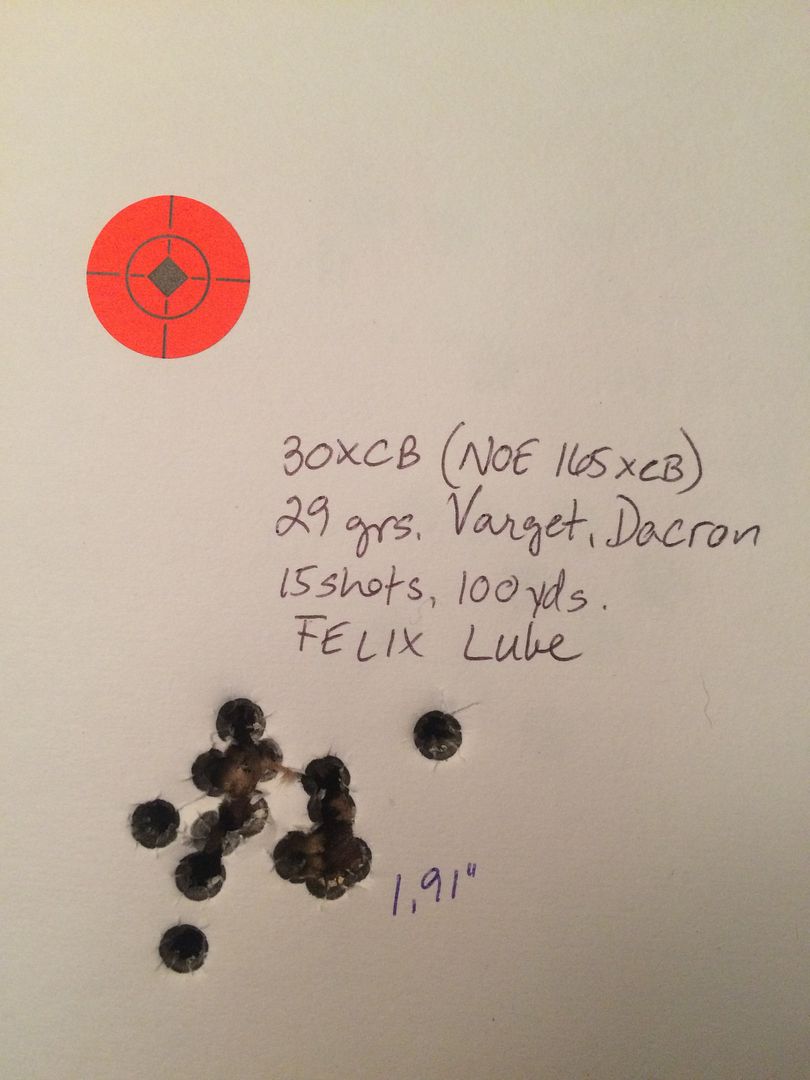
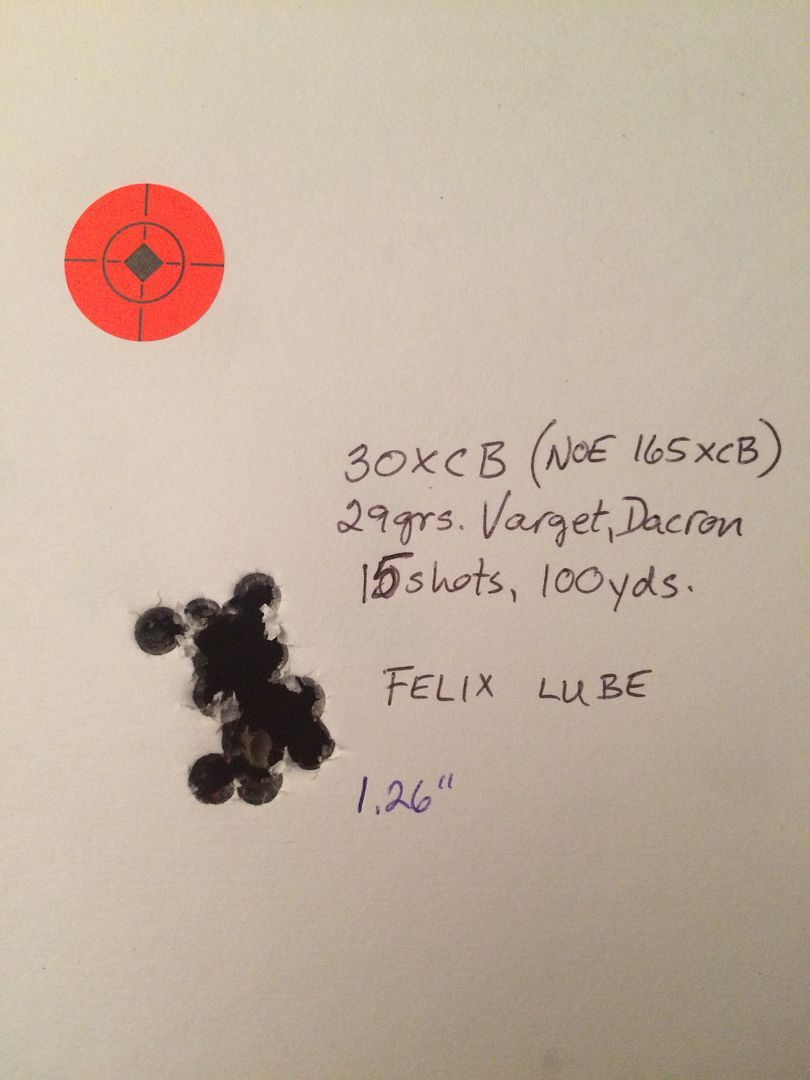
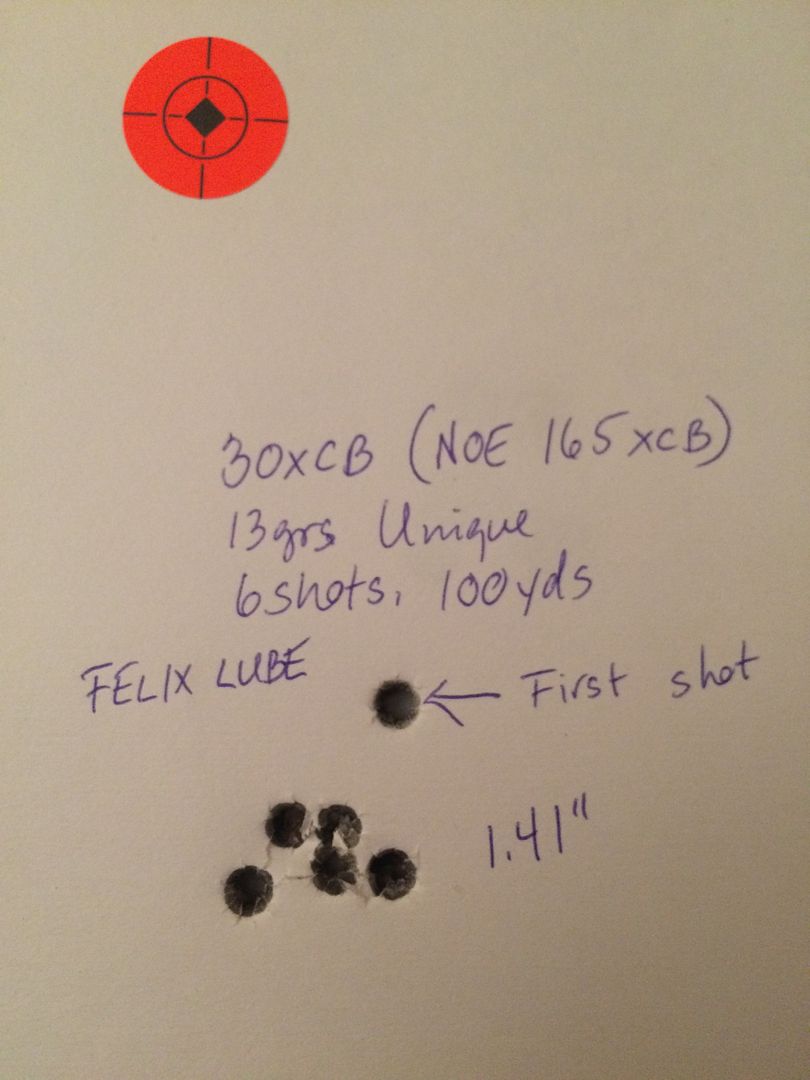
      When I did my “HV lube test” the other day, Geargnasher commented that I hadn’t shot sufficiently large strings for the bore to get conditioned with the lube. I have to admit that he most likely is right, and today I wanted to give this famous lube a fair shake. At the end of the day a hundred rounds lubed with FWFL had gone down the bore, and here are some of the highlights:
      First I shot a few mild loads – 13 grains of Unique. After the first group of 6 I went directly into 3 strings loaded with 28 grains of Varget. The first 2 groups, 15 shots each, were filled with 3/4 gr. Dacron, with the third group (10 shots) I used Puff-Lon as a filler. This is a powdery substance that is compressed (by 20%) between powder and bullet base. I could not detect much difference in accuracy between the two methods.

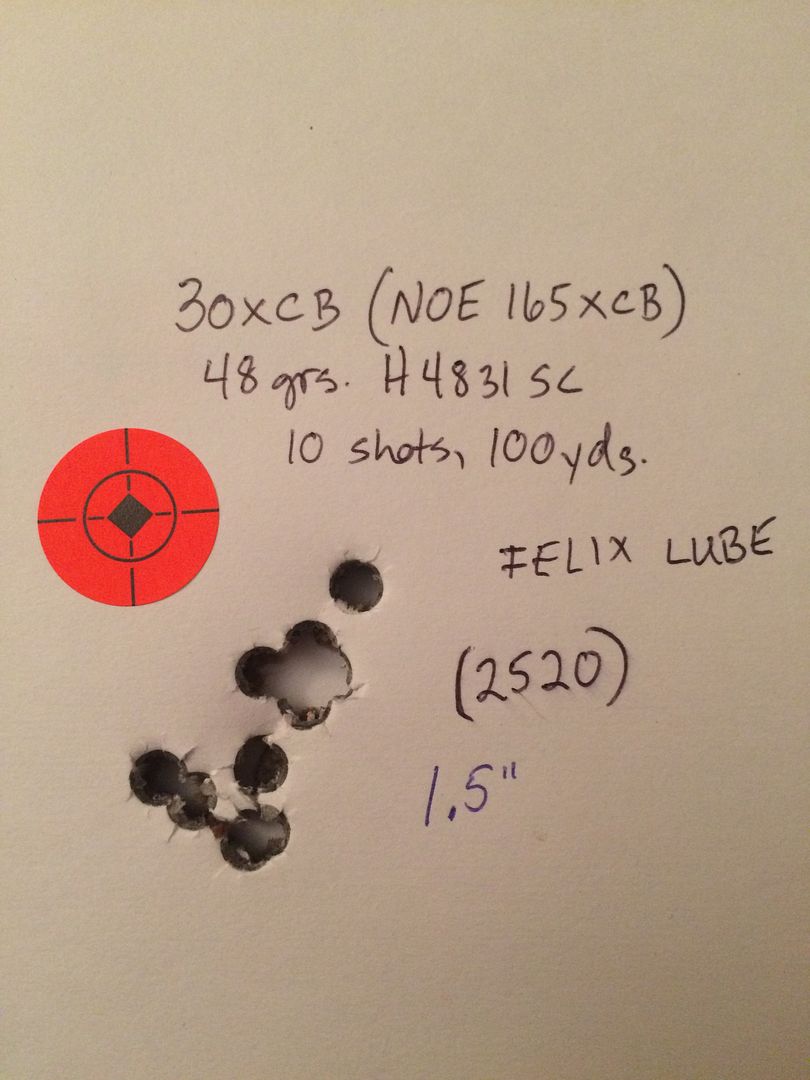
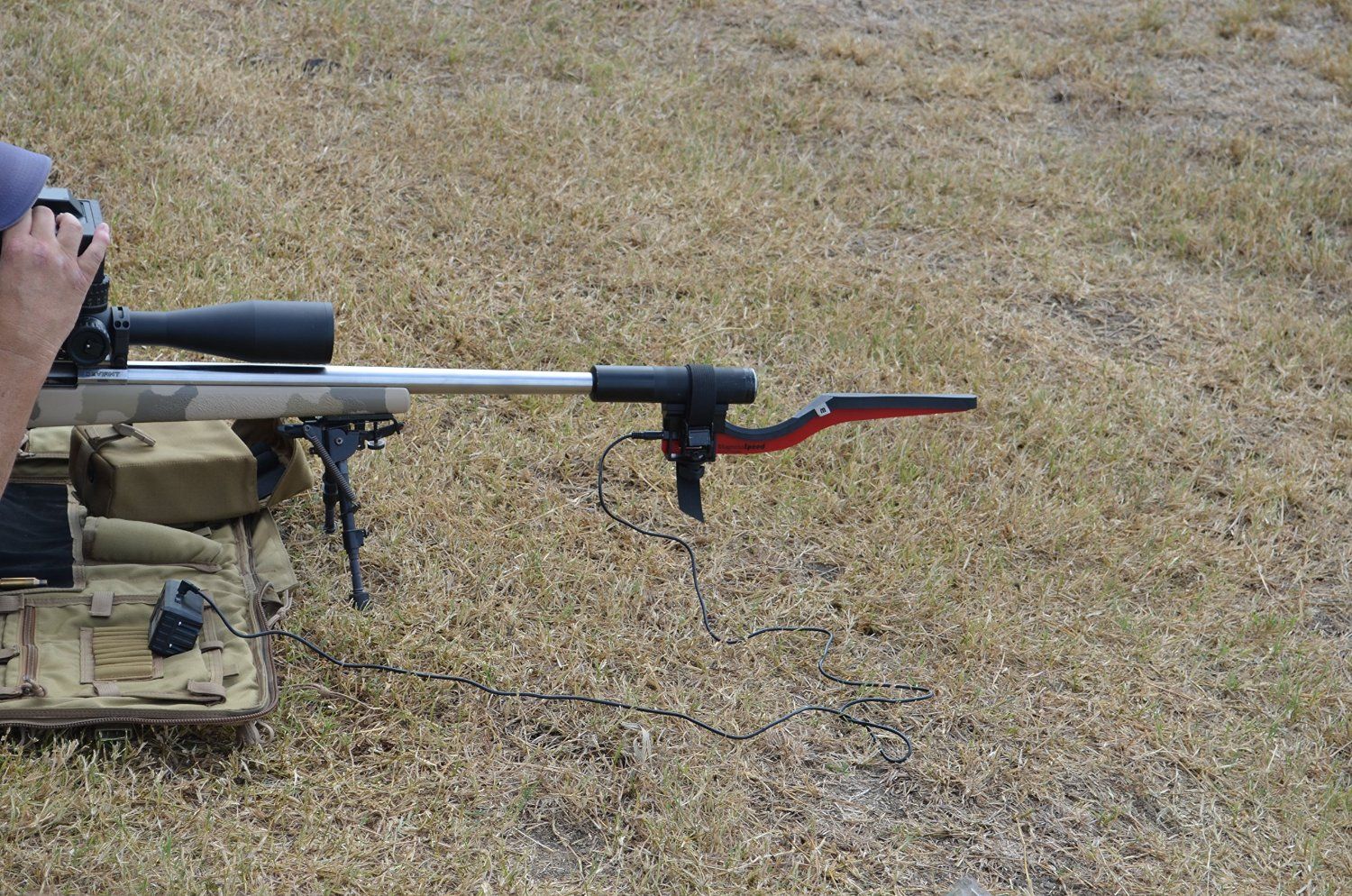
      Then I went straight into some High Velocity stuff. The lube held up very well as the target pictures show. I didn’t set up my chronograph; I have ordered this contraption and it’s being delivered Wednesday:
      A1AcM0TshpL_SL1500__zps3ede08f7.jpg

      It should make documentation much easier, since I like to gather data from all my shooting.
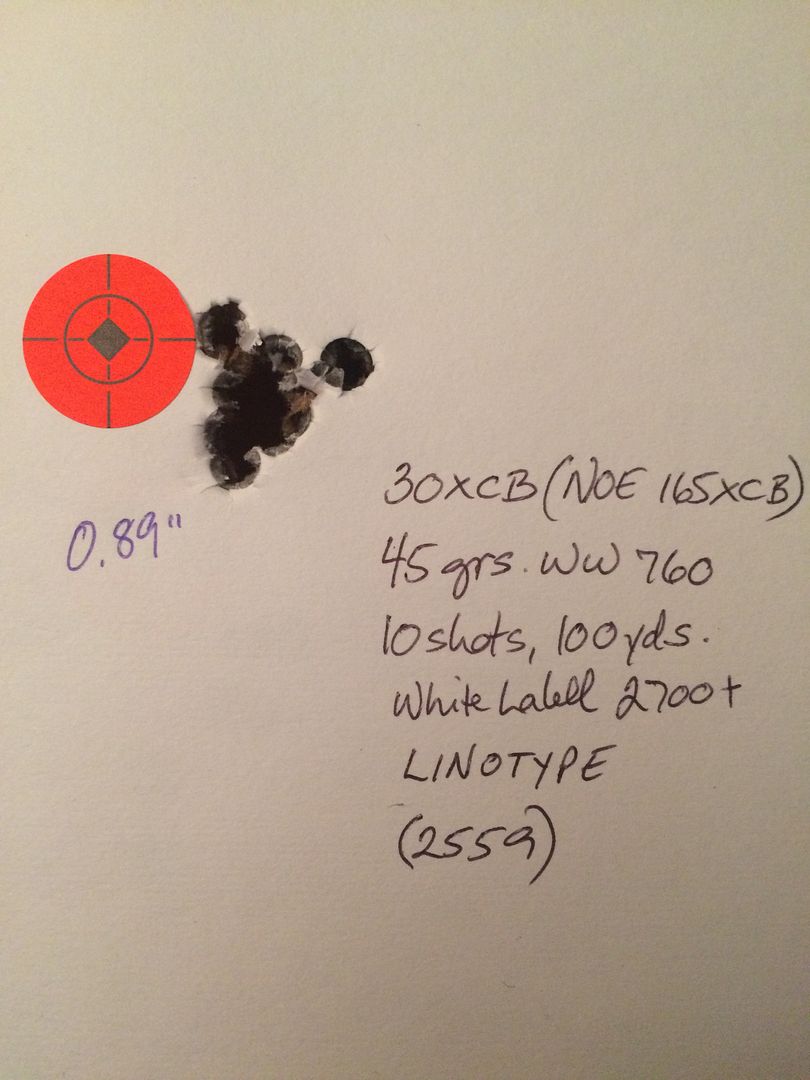
      The numbers in parenthesis next to the HV groups are MVs chronographed with the identical loads earlier, when the rifle’s barrel was 3 1/2″ shorter. It should give a good reference.

      Here are the targets from several of the strings shot with Felix lube:
      IMG_2794_zps4605fda9.jpg
      IMG_2790_zps8358de9e.jpg
      IMG_2791_zpsfb743a50.jpg
      IMG_2792_zps57537446.jpg
      IMG_2793_zps39c76652.jpg
      IMG_2795_zpse9e205af.jpg

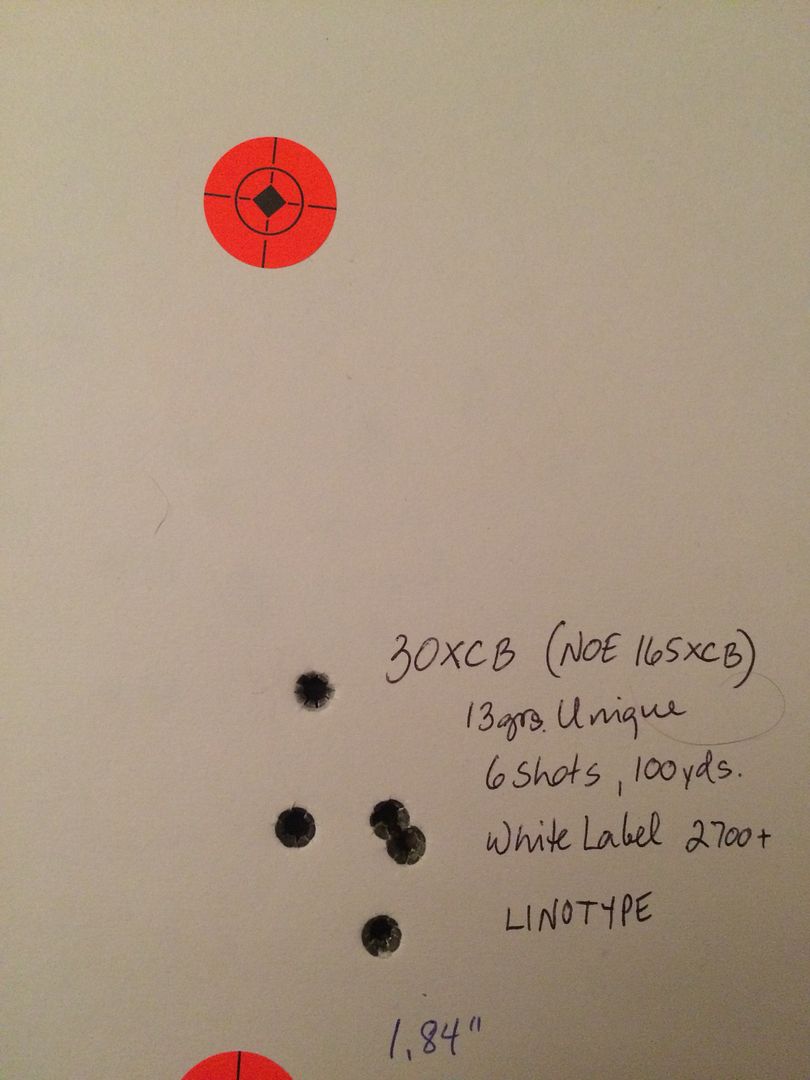
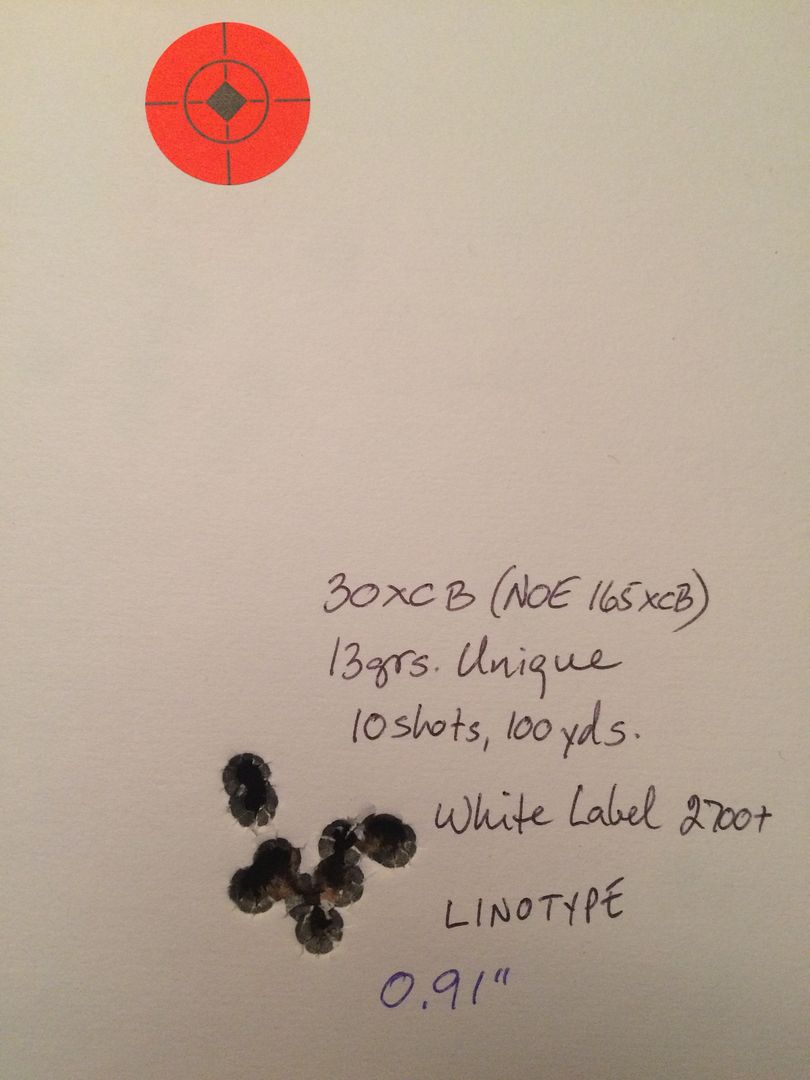
      At this point I scrubbed the bore thoroughly, and changed over to a lube I hadn’t tried before: White Label 2700+, from Lars’ Lubes. I had loaded several strings from mild to wild, and to say that I was impressed with this lube would be an understatement. In earlier conversations with Larry Gibson it was mentioned that this lube could be too stiff and possibly leave lube in the grooves upon muzzle exit. Because of the XCB bullet’s shallow grooves I decided to give it a go and it appears the lube performs as advertised.

      With this lube I also mixed it up and loaded several bullets cast from pure linotype. Those are indicated in the target photos.
      IMG_2796_zpseddf171b.jpg
      IMG_2788_zpsaf4d31b6.jpg
      IMG_2789_zpsf6684294.jpg

      All in all I was very pleased with the way both rifle and loads performed. Not pictured are several groups shot with experimental powders, that didn’t work out well. These loads bombed with both lubes, so no fault there. Hodgdon Superformance just doesn’t shoot well at the velocities we were trying to attain, and more experimenting is needed in this area.

    Viewing 15 replies - 31 through 45 (of 140 total)
    • Author
      Replies
    • #494607
      petermink
        Up
        0
        Down
        ::

        Bjornb,

        Agreed. Settingup the MSV3 is Simple and easy as long as you have something to hold the rifle steady when switching from one rifle to another. Trying to juggle several pieces when all you have is a front and rear bag to hold things from squirming around is a pain At least that’s been my experience.

        Other than that it’s a great outfit and I reccomend it to any one who asks. In these parts we have to deal with winds high enuf that it will blow a regular unit over unless you put some wgt. on the tripod. Gas checks tend to imbed in the front reader of a regular chrono unless you put up some kind of shield. Then of course with regular unit there’s always the chance of putting a bullet hole thru it.  Ask me how I know about these things? :) 50 years of playing with chronographs of one kind or another and I’ve done them all. The MSV3 is the greatest thing to come along for shooting in a LONG time.

        Pete

        #494608
        sgt.mike
          Up
          0
          Down
          ::

          …… However, I really think that the back pressure created by the bullet engrave could have a dramatic effect on the way the powder burns. …….

          Might be as good as any to explain I thought of case volume fill ratio would be close with those powder that gave close to what Bjornb experienced. I do not have a definitive answer off the top of my head for Bjronb

          #494609
          timmalcolm
            Up
            0
            Down
            ::

            I will be adding a little to the testing shortly.
            It has been said that linotype is too hard to hunt with, and that it will shatter upon impact etc etc etc. First, I don’t think it will shatter. Second, while it may be too hard to hunt with at 1900FPS, I don’t know anybody who has tried it at jacketed speeds. I think that it may do quite well, but I don’t know, so I will fire bullets into wet phonebooks/unvulcanized rubber etc etc and see what happens.
            I have been assembling a rifle for myself on the side, and it’s almost finished. I’m naming this one “Felix”.
            IMG_07031_zpsf82e7d16.jpg
            IMG_07021_zps9794527a.jpg
            IMG_07121_zpsda68cde3.jpg
            IMG_07111_zps4f75f15a.jpg

            Action: 1909 Argentine
            Trigger: Timney
            Bedding: Devcon 10-110
            Stock: Arkansas Native black walnut/South American Kingwood/Black micarta
            Barrel: 1-14 twist 27″ long, 1.220 cyl.
            Caliber:30 XCB

            I will use this rifle for the bullet trials backing up Bjornb’s results as I can, and pretty much just so I can enjoy a little of this HV accuracy without a thought in the world except punching little groups in paper at big velocities. 

            #494610
            swheeler
              Up
              0
              Down
              ::

              Felix would be pleased!

              #494612
              timmalcolm
                Up
                0
                Down
                ::

                OK, it’s pretty much finished. Still waiting on the Brux barrel to arrive, but this one will work to put a few bullets in a phonebook or two. LOL!

                IMG_07321_zpsc4752369.jpg
                IMG_07331_zps08f89db0.jpg
                IMG_07341_zps460aa58a.jpg
                IMG_07351_zpsf3bc7984.jpg
                IMG_07361_zpsb06e7b2b.jpg
                IMG_07311_zpsd315be17.jpg

                #494613
                keithsharp
                Participant
                  Up
                  0
                  Down
                  ::

                  That is a very nice and sturdy test bed to iron out loads. What brand and twist is the barrel? Have you worked on taper bumping the 30 XCB bullet? Show grouping test before vs. after taper bumping.  ;) The shorter taper of this bullet will be easier to bump and get more centered.

                  This bullet shows lots of potential. I was thinking of purchasing a .310 diameter  x 1.22 taper reamer to lengthen free bore for test and to cut bump die.

                  I wish there was such thing as a cheap CNC machine to cut hard lead bullets into any shape. It would pump bullets out at the rate of 10 per minute.
                  https://www.youtube.com/watch?v=gNG0dFCN4Ts

                  #494615
                  timmalcolm
                    Up
                    0
                    Down
                    ::

                    The barrel is a mystery. This is the takoff barrel from Bjornb’s target rifle (the one with the bulge). Probably not suitable for target work, but certainly able to shoot some bullets into test media for some observation of hard alloys at these blistering speeds. The critical dimentions are .300/.308, 1-14 twist, 27″ long.

                    I really have no plans to mess with bumping the bullet, as I am very happy with its performance so far, and I have been very pleased with the quality of the bullets as they drop from Al’s molds. They fit the throat’s of these rifles perfectly as dropped, and we are shooting faster than has ever been properly documented on the internet forums.
                    However, if you end up doing a test of using a bump die, please post the results. I would be very interested.

                    On that note, I keep thinking about you flatening your GC’s by gluing them down and sanding the edges perfectly flat.
                    Seems to me that the other side of the check is the more important thing to focus on. Have you considered doing the same thing to the bottoms of the checks? I’m thinking about trying that.

                    #494614
                    keithsharp
                    Participant
                      Up
                      0
                      Down
                      ::

                      I sanded skirts even to help balance the bullet and to grip shank better. Bumping will make the gas check base square without sanding base. A uniform edge at bullets base is important also.

                      I do not expect near perfect groups without a near perfect bullet.

                      #494616
                      timmalcolm
                        Up
                        0
                        Down
                        ::

                        I sanded skirts even to help balance the bullet and to grip shank better. Bumping will make the gas check base square without sanding base. A uniform edge at bullets base is important also.

                        I do not expect near perfect groups without a near perfect bullet.

                        There is iron in your words for all to hear, and I agree completely, but perfection is a measured quantity.
                        I think we both agree that the trailing edge of the GC is much more important than the leading edge. The problem is that sanding the leading edge does practically nothing to square up the trailing edge. The GC’s are formed through a bunting process where the disks are stamped out and a very heavy impression is made in them, after which , the cup is formed rendering the crimp on edge on the inside of the cup.
                        The material in the bottom of the check is of consistent thickness, but is bowed like a potato chip, which effects the outer edges (the trailing edges). The rim is very difficult to make a consistent hight from the bottom of the check, as material flows up one side of the punch more or less than the other side.
                        By sanding the leading edges of the checks, we correct one issue, but this has very little effect on the part that really matters: the trailing edge.
                        If we sand the check’s leading edges and measure them with a .0001 indicator we can see how uneven the base of the checks really are:
                        IMG_07371_zps84922932.jpg
                        In this case we have about .004-.005 variance across the base of the checks.

                        This is very easy to observe if we flip the checks over and apply some blue layout dye to the backs of the checks (you can literally see the odd and uneven curve of the bottom surface of the checks):
                        IMG_07381_zps56b7733c.jpg

                        Then sand them lightly with the precision block and sandpaper:
                        IMG_07391_zpsf3602edd.jpg

                        I was just wondering if you had considered this as a possible way to make the trailing edge of the GC’s more uniform and flat, and if you had measured the squareness to the bullet shank after installation? I intend to do so and observe any effect downrange.
                        Thoughts?

                        #494617
                        timmalcolm
                          Up
                          0
                          Down
                          ::

                          So if we sand further and actually flatten the side that matters to groups, the warped, dished, and inconsistent base becomes flatter and flatter.
                          IMG_07411_zps7d074643.jpg

                          And measureing the check with the .0001 indicator shows near perfection with a TIR of less than .0002 (that’s 1/40th the variance present just flattening the leading edge. Not too shabby.
                          IMG_07421_zps428d325f.jpg

                          #494618
                          anthonylafleur
                          Participant
                            Up
                            0
                            Down
                            ::

                            Veral recommended the cup-faced base punches to squarely seat gaschecks while sizing nose first through the Star years ago (I’m sure any well-aligned push-through sizer will work just as well). I haven’t seen anything better.
                            If a really sharp, square edge is desired, “heat treating” the checks to soften the temper and a closely matched punch-to-sizer die fit will show a marked improvement versus any other method I’ve used.

                            #494619
                            frankelliott
                            Participant
                              Up
                              0
                              Down
                              ::

                              Tim,
                              One thing to consider in doing them that way, is that the metal that they are made of is of uniform thickness and after you sand them, it no longer will be and that will leave a unbalanced GC.

                              I use a arbor press and a punch to both flatten the GC and open it to my size requirement.

                              Frank

                              #494620
                              daveridenour
                              Participant
                                Up
                                0
                                Down
                                ::

                                Tim,

                                I never realized there was that much variation in the checks. Thanks for posting those photos. One more thing to consider now.

                                Dave

                                #494621
                                keithsharp
                                Participant
                                  Up
                                  0
                                  Down
                                  ::

                                  Tim,
                                  Hornaday and all others do not have equal skirt length, skirt length can vary with each check (one side taller than the other). You can actually see the difference when sanding. This is why I sand all skirts LEADING EDGE equal length and square.  This MAY help balance bullet better when spinning. Some target shooters would actually spin each cast bullet  (I forget the device used) to see how well balanced the bullets were before loading.

                                  It is a big mistake to sand the base of checks. DOH

                                  #494622
                                  timmalcolm
                                    Up
                                    0
                                    Down
                                    ::

                                    Tim,
                                    Hornaday and all others do not have equal skirt length, skirt length can vary with each check (one side taller than the other). You can actually see the difference when sanding. This is why I sand all skirts LEADING EDGE equal length and square.  This MAY help balance bullet better when spinning. Some target shooters would actually spin each cast bullet  (I forget the device used) to see how well balanced the bullets were before loading.

                                    It is a big mistake to sand the base of checks. DOH

                                    I have several thoughts.
                                    1. “It’s a big mistake to sand the base of checks” Source? Experiences?
                                    2. Sanding the bases may not be necessary. What if just a few swipes were made with a flat object to find those checks that were truly flat, or consistent?
                                    What if I only used the checks that had the dot perfectly centered?
                                    3. A punch was mentioned that could be used to uniform the bases. That is no problem for me, and I will try it.
                                    4. The check is the very lightest part of the bullet. Seems to me that having a perfect base would be more important than having perfect perfectly balanced checks (which you do not have regardless. Just take a look at them. If one wall is higher than the other, it stands to reason that the wall is of uneven thickness, and this is easily observed to be true just by looking at the wipe marks from the sizing die being heavier on one side than the other almost always).

                                    Please don’t think I am saying this is the way it has to be, and please don’t think I am trying to poo poo your efforts. I’m just saying that I asked the opinion of my most trusted adviser: Mr. Interapid , and I didn’t like what he told me.

                                  Viewing 15 replies - 31 through 45 (of 140 total)
                                  • You must be logged in to reply to this topic.